Protoflow blog
Tribulus and the Testosterone Question
The label prints tribulus and says nothing about hormones. A free ebook that ships with the larger packs says a great deal. So what have controlled trials in men actually found?
Quick answer
In healthy men, controlled trials of tribulus have not shown a rise in testosterone, and the reviews that pool them say so. A 2025 systematic review found that eight of ten studies reported no change in androgen levels, and that the two showing a rise involved men with low testosterone and a small change. For erectile function the trials disagree, and the positive one used about 1,500 mg a day of a standardised extract. This label prints 120 mg of tribulus fruit and makes no hormonal claim, which is the correct thing for it to do.
Start here
Where the question comes from
Tribulus is a botanical whose name is very often followed, in a search box, by a hormone. Type it into a search engine and the suggested completions include tribulus testosterone, does tribulus terrestris boost testosterone and how much tribulus per day for testosterone.
This site has a specific reason to take the question seriously. The larger Protoflow packs ship with four digital bonuses, and one is titled 10 Ways to Turbocharge Your Testosterone. Our post on when the bonus makes the claim looked at that as a matter of regulation: the bottle names no hormone, and the ebook cover names one. It did not ask the follow-up question, which is the one this post asks. If somebody did believe the title, and did think the tribulus in the capsule was the reason, what does the published evidence say about tribulus and testosterone in men?
The answer comes in three parts: trials that measured the hormone directly, reviews that pooled them, and the separate, more mixed evidence for sexual function, which is where tribulus has a slightly better story and where its dosing looks very different from the label’s.
The label
What the label prints
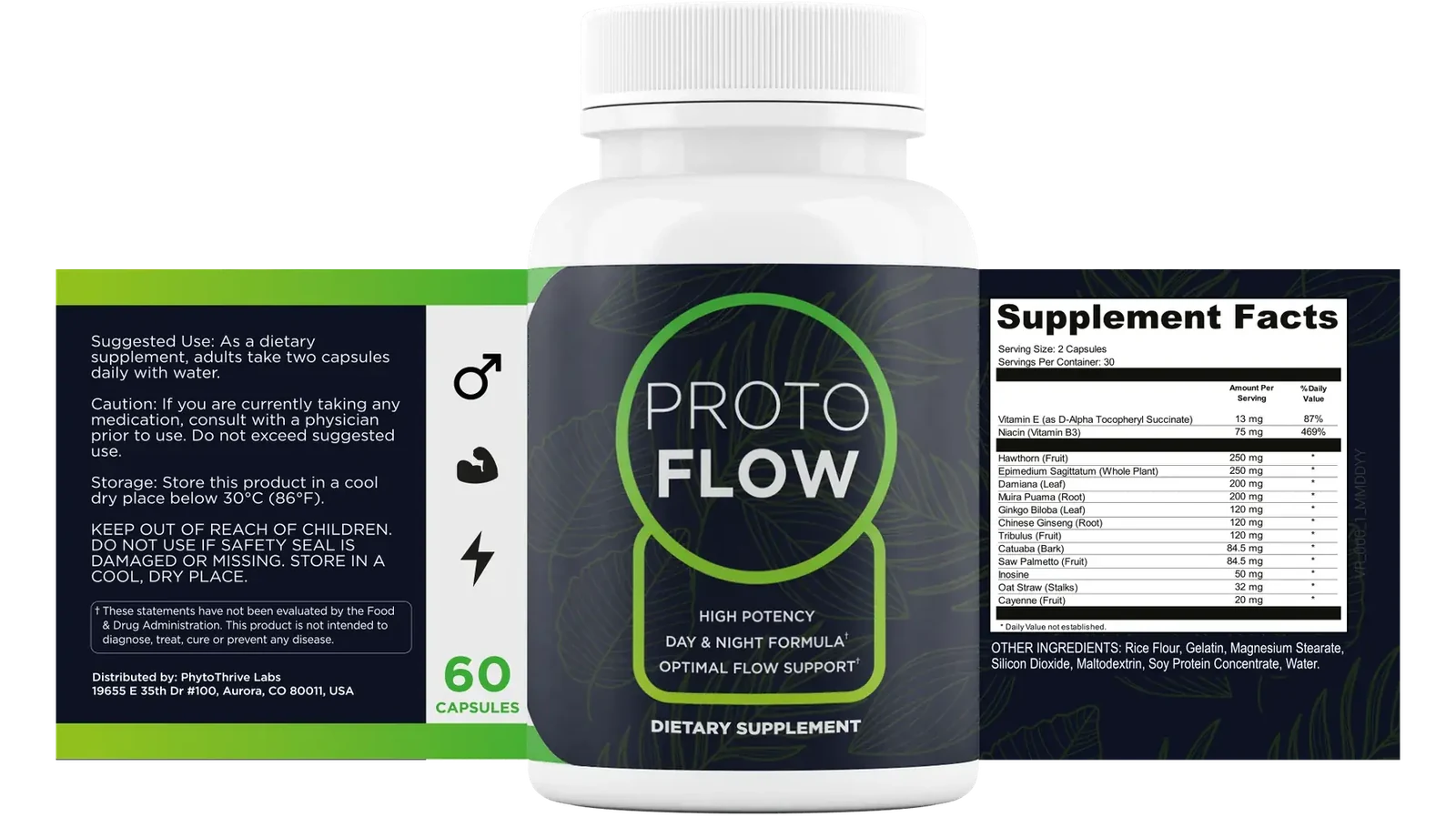
The row reads Tribulus (Fruit), 120 mg, with the “Daily Value not established” asterisk. It is the same figure as ginkgo and Chinese ginseng, in the middle of the panel, and it is a single daily amount, because two capsules is both the serving and the suggested daily use.
What the label does not say is more informative. It does not name a species, though this site reads the row as Tribulus terrestris, the only species the trials below refer to. It does not give an extract ratio or a percentage of saponins, the compounds these products are usually standardised to, so 120 mg describes weight of fruit and no measured content. And the wrap says nothing about testosterone, hormones, muscle or drive. The claims on the front are the general ones, printed with the FDA’s disclaimer.
That last point is the reason this post is fair to the bottle. Nothing printed on the wrap is contradicted by anything below. The problem, where there is one, lies in the ebook title, which is not the label’s.
The evidence
Does tribulus boost testosterone?
| Trial | Who and how long | Daily amount | What they reported |
|---|---|---|---|
| Neychev & Mitev, 2005 (PMID 15994038) | 21 healthy men aged 20 to 36; 4 weeks | 10 or 20 mg per kg of body weight, in three doses | No significant difference from placebo in testosterone, androstenedione or luteinising hormone. All results within the normal range. |
| Antonio et al., 2000 (PMID 10861339) | 15 resistance-trained men; 8 weeks of periodised training | 3.21 mg per kg of body weight | No changes in body weight, percentage fat, dietary intake or mood; the authors concluded tribulus does not enhance body composition or performance. |
| Rogerson et al., 2007 (PMID 17530942) | 22 elite rugby league players; 5 weeks of pre-season training | 450 mg | Strength and fat-free mass rose in both groups with no difference between them; urinary testosterone-to-epitestosterone ratio unchanged. |
| Santos et al., 2014 (PMID 24630840) | 30 men aged 40 or older with erectile dysfunction; 30 days | 800 mg, in two doses | Total testosterone 417.1 to 409.3 ng/dL on tribulus and 442.7 to 466.3 on placebo. No difference in IIEF-5 between groups (P = .79). |
The direct test is simple to describe. Give some men tribulus and some men a placebo, and measure their testosterone. Several groups have done it, in different kinds of men, and the results are consistent.
Neychev and Mitev, in Bulgaria, gave 21 healthy young men either tribulus extract at 10 or 20 mg per kilogram of body weight, or placebo, for four weeks, and took blood at six time points across it (PMID 15994038). Testosterone, androstenedione and luteinising hormone did not differ between the groups, and every result stayed within the normal range. The authors concluded that tribulus saponins possess neither direct nor indirect androgen-increasing properties. The dose is worth noticing: for a man weighing 80 kg, 10 to 20 mg per kilogram is 800 to 1,600 mg a day. That is an illustration, not a subject, since the men in the trial weighed between 60 and 125 kg.
The athletes’ trials found the same thing from the performance end. Resistance-trained men taking about 3.2 mg per kilogram for eight weeks showed no improvement in body composition or exercise performance beyond what placebo produced (PMID 10861339). Elite rugby league players taking 450 mg a day through five weeks of pre-season training gained strength and lean mass, with no difference from their placebo-taking teammates (PMID 17530942). The same paper checked the ratio anti-doping laboratories use to detect testosterone abuse and found it unchanged, which is also an indirect answer to whether the herb raised the hormone.
And in the one trial in this group that recruited men with erectile dysfunction, 30 men aged 40 and over took 800 mg a day for a month (PMID 24630840). Their total testosterone was 417 ng/dL before and 409 after on tribulus, against 443 before and 466 after on placebo. The authors concluded that at the dose and interval studied, tribulus was not more effective than placebo for either erectile symptoms or serum total testosterone.
None of these trials is large, and this post is not going to pretend otherwise. Together they are what the reviews had to work with, and the reviews are less equivocal than you might expect.
The reviews
What the reviews say
| Review | What it included | What it concluded about testosterone |
|---|---|---|
| Qureshi, Naughton & Petroczi, 2014, J Diet Suppl (PMID 24559105) | 11 studies (one a patent application), in animals and in healthy humans | A rise was seen in some animal studies, but in humans only when tribulus was part of a combined supplement. “Evidence to date suggests that TT is ineffective for increasing testosterone levels in humans, thus marketing claims are unsubstantiated.” |
| Morgado et al., 2024, Int J Impot Res (PMID 37697053) | 52 studies of 27 proposed “testosterone boosters”, four of them on tribulus | Most of the boosters, reviewed as a group, “fail to increase total testosterone”. Tribulus was not among the exceptions named in the abstract. |
| Vilar Neto et al., 2025, Nutrients (PMID 40219032) | 10 studies, 483 men, 400 to 750 mg a day for 1 to 3 months | Eight of ten studies reported no significant change in androgen profile. The two that showed a rise did so in men with low testosterone, and the change was small (60 to 70 ng/dL). “No robust evidence was found for increasing testosterone levels.” |
Three reviews, spread over eleven years, say the same thing in slightly different ways, and it is worth reading the last one closely because it is the newest and the fairest about its own limits.
The 2014 review by Qureshi and colleagues set out to test a specific belief, that tribulus enhances testosterone, which it describes as fuelled by marketing information. Of the 11 studies that met its criteria, a limited number of animal studies showed a rise, and in humans a rise was seen only when tribulus was part of a combined supplement, which makes it impossible to credit the herb. It offered a more modest explanation for the effects people do report: a nitric-oxide effect that would work independently of testosterone.
The 2024 review by Morgado and colleagues looked at the whole category of testosterone boosters, 27 of them, across athletes, men with late-onset hypogonadism, infertile men and healthy men. Its blanket finding is that most of them fail to increase total testosterone, and the exceptions it names are other products.
The 2025 review is the most useful for a buyer, because it does not stop at “no effect”. It found that eight of ten studies showed no significant change in androgens, but it noted that the men in those neutral studies did not have low testosterone to start with, and that the two studies with an increase were in men with hypogonadism, where the rise was small: 60 to 70 ng/dL, in within-group comparisons. Its conclusion is measured. There is no robust evidence for raising testosterone, and a low level of evidence for improving erectile function. Half of the studies it included were rated low quality.
That is the fair reading. It is not that tribulus has been proved to do nothing for a man whose testosterone is genuinely low; the evidence there is thin and small. It is that a healthy man taking tribulus for a hormonal boost has no controlled evidence in his favour.
The better story
The erectile function trials, which disagree
Tribulus does have a second reputation, for sexual function, and here the trials genuinely disagree, which makes it the most interesting part of the literature.
The 2025 review found that tribulus improved erectile dysfunction in three of the five studies that assessed it. The largest positive trial, published in Maturitas in 2017, randomised 180 men aged 18 to 65 with mild or moderate erectile dysfunction to tribulus or placebo for 12 weeks (PMID 28364864). The men took a branded product, and each film-coated tablet contained 250 mg of a dried herb extract at a stated ratio of 35–45 to 1, standardised to at least 112.5 mg of furostanol saponins. The dose was three times two tablets a day, so six tablets, which is 1,500 mg of extract daily. The erectile function score improved more on tribulus than on placebo, by 2.70 points (95% CI 1.40 to 4.01) on an intention-to-treat basis, with improvements in intercourse satisfaction, orgasmic function, desire and overall satisfaction, and no difference in adverse events.
Against that stands the trial of 30 men in the table above, where 800 mg a day for 30 days produced no difference from placebo. Both results can be true, because the two trials are so different: 180 men against 30, 12 weeks against 30 days, a standardised branded extract against a dose of unspecified material in the abstract. That is the practical lesson of this whole area. Studies of a herb are studies of a specific product at a specific amount, and a result belongs to that product.
It is also worth noticing what the positive trial did not claim. It measured erectile function in men with erectile dysfunction. The abstract does not report testosterone as an outcome, and the 2014 review proposes a nitric-oxide mechanism that would not run through the hormone.
The arithmetic
The sums
| Trial or review | Daily amount | 120 mg as a share |
|---|---|---|
| Antonio 2000, at 3.21 mg per kg (illustrated for an 80 kg man: about 257 mg) | about 257 mg | about 47% |
| Rogerson 2007 | 450 mg | about 27% |
| Vilar Neto 2025, range across the reviewed studies | 400 to 750 mg | 16% to 30% |
| Santos 2014 | 800 mg | 15% |
| Kamenov 2017, dried extract 35 to 45 to 1 | 1,500 mg of extract | 8% |
The table sets the label’s figure against each daily amount above. As with ginseng, the direction is the same in every row: this capsule contains less tribulus than any trial gave, and in the trial with a clearly positive result, a great deal less. Against the range the 2025 review reports, 400 to 750 mg a day, 120 mg is between a sixth and a third.
The caveat needs stating with the same care as before. That does not prove that 120 mg does nothing. It does mean that no trial in this post tested the amount, and that the only positive result was for a standardised extract that the label’s bare “Fruit, 120 mg” cannot be equated with. If the 120 mg is plain ground fruit and the trial used a concentrated extract, the label carries even less active material than the 8 per cent suggests. That is not a criticism peculiar to this bottle; it is the ordinary consequence of a category in which most labels print a weight and nothing else, and the nine-check method on this site is built around asking for the ratio.
For the testosterone question, the sums barely matter, because the answer in healthy men is negative at 800 to 1,600 mg a day (for an 80 kg man) as well as at lower amounts. Nobody has found the dose at which it works, so nobody can say 120 mg is short of it.
Safety
Tribulus side effects
The safety picture is mostly quiet, with one thing you should hear about rather than have discovered later.
The reassuring part first. In the 180-man Maturitas trial, there was no difference in the incidence of adverse events between tribulus and placebo, and no drug-related serious adverse events. This site’s ingredients page records no NCCIH page and no NIH fact sheet for tribulus, so there is no federal summary to quote in either direction, which is the position seven of the eleven botanicals on this panel are in.
Now the part to hear. A 2024 case report in ACG Case Reports Journal describes a 46-year-old man who took tribulus supplements daily for two months and developed severe jaundice and admission to hospital, with a peak bilirubin of 48 mg/dL, kidney dysfunction, and a liver biopsy consistent with drug-induced liver injury (PMID 38328764). He was treated with three sessions of plasmapheresis, recovered kidney function, and had a bilirubin of 1.1 mg/dL at follow-up. The authors note that tribulus has been linked to severe jaundice and death in grazing animals, and that only a few case reports of liver toxicity in humans exist.
How much weight should a single report carry? Not a great deal, and not none. One case cannot tell you how often such an event occurs, and the abstract does not say what product or dose was involved, so it is impossible to say what it implies for a 120 mg row. But it is a documented serious event, and a person with liver or kidney disease, or one taking other medicines, has a reason to raise it. That is also the reason the label’s caution line, to consult a physician before use if you take any medication, is worth following rather than skipping.
Back to the bonus
What this means for the bonus
Return to where this started. The label prints tribulus at 120 mg and names no hormone, and in that it is careful. The ebook that ships with the larger packs names a hormone in its title, and nothing in the controlled trials above supports the idea that tribulus, at any amount studied, is a way to raise it in a healthy man.
That is a fair thing to say without being unfair to the product, because the product does not say the reverse. The distance between the two documents in a parcel is exactly the distance our earlier post described: one has to stand behind its words and one does not. What you can do about it is small and free. If a title promises a hormone, ask which ingredient is supposed to deliver it, then look up whether anyone has tested that ingredient on that outcome, in people like you, at the amount in your bottle. For tribulus, the ingredient has been tested on that outcome in healthy men and the result was no rise, and no trial has tested the 120 mg amount.
The ginseng post does the same exercise for the row with the best federal evidence, and Seven of Eleven explains why tribulus, like six other rows, has no federal page to read at all.
The rule
When a claim names a hormone, look for a controlled trial that measured that hormone in people like you at the amount you would take. If the only evidence is a rise in some animals or in a combined product, it is not evidence about the herb.
Closing
The honest version
The honest version
The controlled evidence does not show that tribulus raises testosterone in healthy men, and three reviews between 2014 and 2025 say so. For erectile function the trials disagree, and the clearest positive result used about 1,500 mg a day of a standardised extract, where this label prints 120 mg of fruit with no ratio. A single case report links tribulus to serious liver injury, which is a reason for care rather than a measure of risk. The label itself makes no hormonal claim and is right not to; the ebook title is the part that outruns the evidence. To the label’s credit, it prints the amount, and that made every comparison here possible.
References
Sources
- Neychev VK, Mitev VI. The aphrodisiac herb Tribulus terrestris does not influence the androgen production in young men. J Ethnopharmacol. 2005 Oct 03;101(1-3):319-23. PMID 15994038.
- Antonio J, Uelmen J, Rodriguez R, Earnest C. The effects of Tribulus terrestris on body composition and exercise performance in resistance-trained males. Int J Sport Nutr Exerc Metab. 2000 Jun;10(2):208-15. PMID 10861339.
- Rogerson S, Riches CJ, Jennings C, Weatherby RP, Meir RA, Marshall-Gradisnik SM. The effect of five weeks of Tribulus terrestris supplementation on muscle strength and body composition during preseason training in elite rugby league players. J Strength Cond Res. 2007 May;21(2):348-53. PMID 17530942.
- Santos CA, Reis LO, Destro-Saade R, Luiza-Reis A, Fregonesi A. Tribulus terrestris versus placebo in the treatment of erectile dysfunction: A prospective, randomized, double blind study. Actas Urol Esp. 2014 May;38(4):244-8. doi:10.1016/j.acuro.2013.09.014. PMID 24630840.
- Qureshi A, Naughton DP, Petroczi A. A systematic review on the herbal extract Tribulus terrestris and the roots of its putative aphrodisiac and performance enhancing effect. J Diet Suppl. 2014 Mar;11(1):64-79. doi:10.3109/19390211.2014.887602. PMID 24559105.
- Morgado A, Tsampoukas G, Sokolakis I, Schoentgen N, Urkmez A, Sarikaya S. Do "testosterone boosters" really increase serum total testosterone? A systematic review. Int J Impot Res. 2024 Jun;36(4):348-364. doi:10.1038/s41443-023-00763-9. PMID 37697053.
- Vilar Neto JO, de Moraes WMAM, Pinto DV, da Silva CA, Caminha JSR, Nunes Filho JCC, et al. Effects of Tribulus (Tribulus terrestris L.) Supplementation on Erectile Dysfunction and Testosterone Levels in Men-A Systematic Review of Clinical Trials. Nutrients. 2025 Apr 06;17(7). doi:10.3390/nu17071275. PMID 40219032.
- Kamenov Z, Fileva S, Kalinov K, Jannini EA. Evaluation of the efficacy and safety of Tribulus terrestris in male sexual dysfunction-A prospective, randomized, double-blind, placebo-controlled clinical trial. Maturitas. 2017 May;99:20-26. doi:10.1016/j.maturitas.2017.01.011. PMID 28364864.
- Mohy-Ud-Din N, Jonassaint N. Severe Liver and Renal Injury From Tribulus Terrestris. ACG Case Rep J. 2024 Feb;11(2):e01267. doi:10.14309/crj.0000000000001267. PMID 38328764.
Order Protoflow from the official page
60 capsules a bottle, two capsules a day with water, so thirty days a bottle. Fourteen ingredients with fourteen published amounts and no proprietary blend, which is the reason every check on this site can be run at all. The capsule shell is gelatin. 60 days from purchase to change your mind. The order desk is +1 (302) 200-3480.
Price shown at checkout · 60-day window from the date of purchase · ships from inside the US · the label’s own support line is +1 (302) 200-3480
Next
Keep reading
When the bonus makes the claim
The bottle names no hormone. The free download that arrives with the larger packs names one in its title.
Read it →What 120 mg of ginseng is up against
The one botanical with a positive federal sentence, read against the trials behind it.
Read it →Choosing a botanical blend
The nine checks worth running before you pay for any multi-herb bottle.
Read it →