Protoflow blog
What 120 mg of Ginseng Is Up Against
Of the eleven botanicals in this capsule, exactly one comes with a positive sentence from a federal body. This post goes and reads the trials behind that sentence, and then does the sum the label leaves to you.
Quick answer
The trials behind the ginseng row’s good reputation gave men 2,700 to 3,000 mg of Korean red ginseng a day. This label prints 120 mg of Chinese ginseng root in a two-capsule serving, about 4 per cent of those amounts, with no extract ratio and no statement of which preparation it is. The most rigorous review of the trials, from Cochrane, calls the effect on erectile function trivial, on mostly low-certainty evidence. None of that is a finding that the row does nothing. It is a finding that nobody has tested this amount.
Start here
The one row with a good sentence
Go down this panel with the federal pages open beside it and a pattern appears quickly. Ginkgo gets “no conclusive evidence that ginkgo is helpful for any health condition”. Saw palmetto gets a review that found little or no benefit. Hawthorn gets a sentence about conflicting evidence. Seven of the eleven botanicals get nothing at all, because no consumer summary exists. Our earlier post on that count laid it out.
Then there is Chinese ginseng. The National Center for Complementary and Integrative Health writes about Asian ginseng, and its sentence is the friendliest one anywhere on this panel: “Some research shows that taking oral Asian ginseng seems to improve sexual function in people with erectile dysfunction (ED).”
It is a careful sentence. It says “seems”. It is about people with a diagnosed condition, not about everybody. And it is a summary, which means a lot of study design has been folded away underneath it. This post unfolds it. What did those studies give people, for how long, and how big was the effect? Then, and only then, it holds the answer up against the number printed on the bottle.
One boundary first. The Protoflow label names no condition at all. It carries the usual disclaimer, a general caution line, and the words “optimal flow support” on the front. Erectile dysfunction comes into this post because that is the condition the ginseng trials were run on, not because the label claims anything about it. If that condition is the reason you are reading, it is a question for a clinician before it is a question for a supplement shelf.
The label
What the label actually prints
Here is the row as the wrap prints it: Chinese Ginseng (Root), 120 mg, with an asterisk pointing to “Daily Value not established.” The serving is two capsules, and the suggested use is two capsules daily with water, so 120 mg is the whole daily amount.
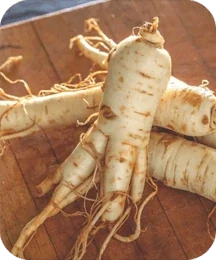
Three things are worth noticing about what is not printed. There is no Latin name. This site reads “Chinese ginseng” as Panax ginseng, the plant NCCIH calls Asian ginseng, but the bottle does not say so. There is no extract ratio and no standardisation to a named compound, which means 120 mg describes weight of material and not any measured activity. And there is no statement of whether the root is dried white ginseng or the steamed form sold as red ginseng, a distinction that matters in a moment because the trials used the steamed one.
In fairness, the amount is printed, and that is not a small thing. Ginseng is one row among fourteen, each with its own figure, and no proprietary blend hides any of them. The supplement facts page transcribes the whole panel. The point here is narrower: an honestly printed number can still be a small one.
The evidence
How much ginseng per day did the trials use?
| Trial | Design | Daily amount given | What they reported |
|---|---|---|---|
| Choi, Seong, Rha, 1995 (PMID 8750052) | 90 men, 30 per group: ginseng, placebo or trazodone | Not stated in the abstract | Overall efficacy 60% for ginseng against 30% for placebo and for trazodone. No complete remission; partial responses only. |
| Hong et al., 2002 (PMID 12394711) | 45 men, double-blind crossover: 8 weeks on, 2 weeks washout, 8 weeks on | 900 mg three times daily, or 2,700 mg | IIEF scores higher on ginseng than on placebo (38.1 against 30.9, p < 0.01). 60% said erections improved. |
| de Andrade et al., 2007 (PMID 16855773) | 60 men with mild to moderate ED, double-blind, 12 weeks | 1,000 mg three times daily, or 3,000 mg | IIEF-5 rose from 16.4 to 21.0 on ginseng and from 17.0 to 17.7 on placebo. Testosterone unchanged. |
This is a question people type into search engines in several forms — how much ginseng per day, ginseng dosage for men — and the honest answer depends entirely on which ginseng and for what purpose. For the erectile dysfunction literature, the answer can be read straight out of the abstracts.
The trials in the table are the ones the later reviews keep returning to, and all three used Korean red ginseng. The 2008 systematic review, whose authors include Edzard Ernst, defines it in its own abstract as unskinned Panax ginseng that is steamed or otherwise heated and then dried (PMID 18754850).
Two of the three abstracts state the amount, and it is large. Hong and colleagues gave 900 mg three times a day. de Andrade and colleagues gave 1,000 mg three times a day. Those are daily totals of 2,700 mg and 3,000 mg. The 1995 trial by Choi and colleagues, which compared ginseng with both a placebo and the drug trazodone, does not print its dose in the abstract, so this post does not guess one.
The results deserve a plain reading too. In the crossover trial, men scored higher on the International Index of Erectile Function while on ginseng, and 60 per cent answered that it improved their erections. In the 2007 trial, the five-item score went from 16.4 to 21.0 on ginseng and barely moved on placebo, and testosterone was the same in both groups. In the 1995 trial, frequency of intercourse, premature ejaculation and morning erections did not change in any group, while early detumescence, penile rigidity and girth, libido and satisfaction scored significantly better on ginseng. The authors were careful to say that no man was completely cured, only partly better.
Those are encouraging results from small, early trials. They are also what NCCIH’s sentence rests on. Notice, though, what the sentence does not say: it does not say anything about how much.
The arithmetic
The sum
The dashed track is the daily amount given in each trial. The solid bar is the 120 mg this panel declares as the whole daily serving.
Now the sum the label leaves to you. Divide 120 by 2,700 and you get 0.044. Divide 120 by 3,000 and you get 0.04. Put the other way round, the trials gave twenty-two and a half to twenty-five times what this capsule contains.
What that comparison shows is a limit, so it is worth stating the limit carefully rather than overstating it. It does not show that 120 mg is ineffective. None of the abstracts quoted here describes a comparison of different amounts against each other, so there is no line to draw from 3,000 mg down to 120 mg, and a herb does not have to behave in proportion to its dose. But it also means there is no trial at this amount for the sentence to lean on. The good federal sentence is about an intake that the panel does not reach.
Two further gaps sit on top of the quantity gap. The trials used Korean red ginseng, a steamed preparation, and the label does not say what preparation it uses. And the two trials whose abstracts state a duration ran for 8 and 12 weeks in men with a specific diagnosis, which is a different situation from a healthy adult taking two capsules a day for general reasons. Each of those is a place where the evidence could fail to carry over, and the label gives no way of checking any of them.
The reviews
Three reviews, three tones
| Review | What it included | Headline result | Its own verdict |
|---|---|---|---|
| Jang et al., 2008, Br J Clin Pharmacol (PMID 18754850) | 7 randomised trials of red ginseng; 6 against placebo (n = 349) | Risk ratio 2.40 (95% CI 1.65 to 3.51) for a positive response | “Suggestive evidence.” Methodological quality low on average; more rigorous studies needed. |
| Borrelli et al., 2018, Drugs (PMID 29633089) | 24 trials of herbal supplements for ED (2,080 men), five on ginseng (n = 399) | IIEF-5 standardised mean difference 0.43 (95% CI 0.15 to 0.70) for ginseng | “Encouraging evidence”; larger, higher-quality studies required. Only seven trials had a mostly low risk of bias. |
| Lee et al., 2021, Cochrane (PMID 33871063) | 9 trials, 587 men with mild to moderate ED, all against placebo, follow-up up to 12 weeks | IIEF-5 mean difference 2.39 (95% CI 0.89 to 3.88), moderate certainty | “Trivial effects” on erectile function or satisfaction, on mostly low-certainty evidence. |
If you read only the abstracts of the three main reviews, you could come away with three different impressions of the same pile of trials. They are not contradicting each other so much as answering slightly different questions to different standards, and it is worth seeing how.
The 2008 review pooled six placebo-controlled trials and found that men on red ginseng were about two and a half times as likely to report a positive response. Its own authors called the evidence suggestive rather than convincing, because the trials were small and their quality was low on average. The 2018 review widened the frame to all herbal supplements for erectile dysfunction, pooled the ginseng trials, found a standardised improvement on the IIEF-5 questionnaire, and called the evidence encouraging. It also noted that adverse events did not differ significantly between placebo and treatment in the placebo-controlled trials.
The 2021 Cochrane review is the most cautious and, because of how Cochrane grades evidence, the most useful. It opens by saying that individual studies of ginseng are “mostly small, of uneven methodological quality and have unclear results”. It found the difference between ginseng and placebo to be statistically detectable but small: on the IIEF-15 erectile function domain, 3.52 points on a 1-to-30 scale, where the minimal clinically important difference it assumed was 4; on the IIEF-5, 2.39 points on a 1-to-25 scale, where it assumed 5. It also found that ginseng may improve men’s self-reported ability to have intercourse (risk ratio 2.55, 95% CI 1.76 to 3.69), on low-certainty evidence, and it found no trial comparing ginseng with the standard drugs for erectile dysfunction.
Reading it properly
What “trivial” means here
The word deserves a slower look, because it sounds harsher than the number behind it. In a Cochrane review, calling an effect trivial does not mean it was not there. The confidence interval for the IIEF-5 difference, 0.89 to 3.88, sits entirely above zero. Something was measured. What the reviewers mean is that the size of it falls short of the amount a man would notice as a real change in his day-to-day function.
That gives the whole picture a fair shape, and it reconciles all three reviews and the NCCIH sentence at once. There is a real but small signal in short trials in men with mild to moderate erectile dysfunction, at amounts of red ginseng roughly twenty-five times what this label prints. “Seems to improve” is a fair way to say that in one line for the public. “Trivial” is a fair way to say it for a reader who wants to know how much.
A fourth paper is worth adding because it looked at products rather than herbs. In 2023, Petre and colleagues examined the dietary supplements marketed for erectile dysfunction in Italy and scored them against the evidence for their ingredients and a minimal effective daily dose they worked out for each one (PMID 37686709). Their abstract reports that Panax ginseng, Tribulus terrestris and L-arginine were among the ingredients able to improve male sexual function in the pooled trials, and that marketed products are “usually blends of many substances that are frequently employed at a negligible dose or without any evidence”. The abstract does not print their minimal effective dose for ginseng, so we do not either; it is in the full paper if you want it. The general lesson applies to every multi-ingredient capsule: a herb’s name on the label and a herb’s dose in the trials are two separate facts.
This is also why the row is worth understanding rather than dismissing. It is the one place on this panel where a federal body found something. It is simply that what it found was found at a different amount.
Safety
Ginseng side effects, briefly
Ginseng side effects are a common search, so here is what the same sources say, compactly. The full treatment is on the side effects page.
NCCIH says short-term oral use of Asian ginseng in recommended amounts “appears to be safe for most people”, and that insomnia is “the herb’s most common side effect”. It adds that Asian ginseng “might lower blood sugar levels” and “may worsen autoimmune disorders and interfere with blood clotting”. In the trials, the Cochrane review found that ginseng may have little to no effect on adverse events compared with placebo, though its confidence interval was wide (risk ratio 1.45, 95% CI 0.69 to 3.03, low certainty). Wide means the trials were too small to rule out either a modest excess or a modest deficit.
The bleeding caution is the one specific to this bottle, because ginseng is not alone. Vitamin E and ginkgo each carry a published caution about anticoagulant drugs too, and all three sit in the same two-capsule serving. If you take a blood thinner or an antiplatelet drug, that combination is a conversation with a pharmacist before it is a purchase, which is exactly what the label’s own caution line tells you: consult a physician prior to use if you are currently taking any medication.
Practical
How to use this post
The habit worth keeping is small. When a label names a herb, and a headline says that herb has been studied, ask three questions before you credit one with the other.
- Which preparation? Trials name their material. Korean red ginseng at a stated weight is a different object from an unspecified “root”, and a label that does not say which it is has told you less than it appears to.
- How much, and for how long? Read the daily amount in the abstract. If the number on your bottle is a small fraction of it, the study describes a different intake from yours.
- How big was the effect, and did anyone call it small? Statistical significance and clinical size are separate things, and Cochrane reviews say plainly which one they mean.
The same three questions work on the rest of the panel. Our post on the bonus and the claim covers how wording travels from a study into a marketing pack, and the ingredients page runs all fourteen rows through the federal pages that exist.
The rule
A positive federal sentence about a herb describes the amount the trials gave, in the people they studied. Divide the amount on your bottle by the amount in the trial before you let the sentence apply to it.
Closing
The honest version
The honest version
Ginseng is the only row on this panel with a positive federal finding, and the evidence behind it is modest. The trials gave 2,700 to 3,000 mg of Korean red ginseng a day; the label prints 120 mg of Chinese ginseng root with no ratio and no stated preparation. The best review, from Cochrane, calls the benefit trivial on mostly low-certainty evidence. None of that shows the 120 mg row is inert, and none of it shows harm. What it shows is that nobody has tested this amount, and that the good sentence should be read as being about a different dose. To this label’s credit, it prints the figure plainly, which is the reason the sum above could be done at all.
References
Sources
- Lee HW, Lee MS, Kim TH, Alraek T, Zaslawski C, Kim JW, et al. Ginseng for erectile dysfunction. Cochrane Database Syst Rev. 2021 Apr 19;4(4):CD012654. doi:10.1002/14651858.CD012654.pub2. PMID 33871063.
- Jang DJ, Lee MS, Shin BC, Lee YC, Ernst E. Red ginseng for treating erectile dysfunction: a systematic review. Br J Clin Pharmacol. 2008 Oct;66(4):444-50. doi:10.1111/j.1365-2125.2008.03236.x. PMID 18754850.
- Borrelli F, Colalto C, Delfino DV, Iriti M, Izzo AA. Herbal Dietary Supplements for Erectile Dysfunction: A Systematic Review and Meta-Analysis. Drugs. 2018 Apr;78(6):643-673. doi:10.1007/s40265-018-0897-3. PMID 29633089.
- Hong B, Ji YH, Hong JH, Nam KY, Ahn TY. A double-blind crossover study evaluating the efficacy of korean red ginseng in patients with erectile dysfunction: a preliminary report. J Urol. 2002 Nov;168(5):2070-3. PMID 12394711.
- Choi HK, Seong DH, Rha KH. Clinical efficacy of Korean red ginseng for erectile dysfunction. Int J Impot Res. 1995 Sep;7(3):181-6. PMID 8750052.
- de Andrade E, de Mesquita AA, Claro Jde A, de Andrade PM, Ortiz V, Paranhos M, et al. Study of the efficacy of Korean Red Ginseng in the treatment of erectile dysfunction. Asian J Androl. 2007 Mar;9(2):241-4. PMID 16855773.
- Petre GC, Francini-Pesenti F, Vitagliano A, Grande G, Ferlin A, Garolla A. Dietary Supplements for Erectile Dysfunction: Analysis of Marketed Products, Systematic Review, Meta-Analysis and Rational Use. Nutrients. 2023 Aug 22;15(17). doi:10.3390/nu15173677. PMID 37686709.
Order Protoflow from the official page
60 capsules a bottle, two capsules a day with water, so thirty days a bottle. Fourteen ingredients with fourteen published amounts and no proprietary blend, which is the reason every check on this site can be run at all. The capsule shell is gelatin. 60 days from purchase to change your mind. The order desk is +1 (302) 200-3480.
Price shown at checkout · 60-day window from the date of purchase · ships from inside the US · the label’s own support line is +1 (302) 200-3480
Next
Keep reading
Seven of eleven
Which of the botanicals in this capsule have a federal consumer page, and what the absence does and does not mean.
Read it →Side effects and safety
Every federal safety statement that touches this bottle, ingredient by ingredient.
Read it →All fourteen, with their amounts
Every row on the panel and the federal page that covers it, where one exists.
Read it →