Label guide
ProtoFlow Ingredients: A Row-by-Row Guide to the Supplement Facts Label
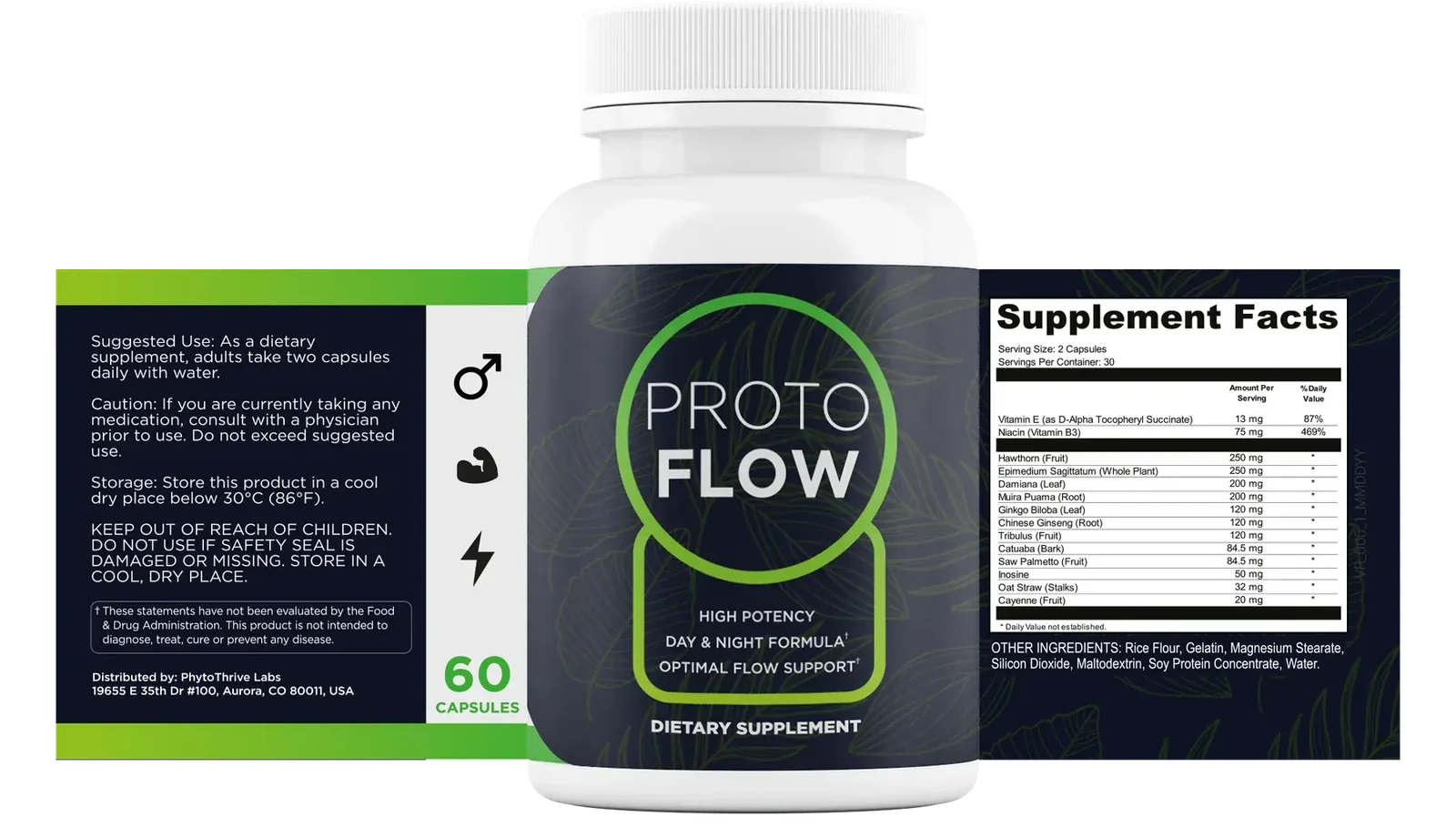
ProtoFlow ingredients are fourteen rows on the Supplement Facts panel, each with its own amount and no proprietary blend. Two capsules give vitamin E 13 mg, niacin 75 mg, hawthorn 250 mg and epimedium 250 mg, plus damiana, muira puama, ginkgo, Asian ginseng, tribulus, catuaba, saw palmetto, inosine, oat straw and cayenne. The other ingredients line lists gelatin and soy protein concentrate.
Quick answer
Read the serving size first: two capsules, 30 servings a bottle. Then the amounts, the %DV column, the asterisk footnote, the other-ingredients line and the caution. The ProtoFlow panel lists fourteen ingredients with fourteen amounts and no proprietary blend. It does not name the niacin form, extract strength or allergens.
On this page
- What is the first thing to read on the ProtoFlow label?
- What do the columns on the panel mean?
- Key facts
- What does the asterisk mean?
- Why does it say d-alpha tocopheryl succinate?
- What are the other ingredients, and what do they tell you?
- What do the directions, caution and storage lines say?
- How do the numbers add up, and what is missing?
- Which label and buying facts should you remember?
- Frequently asked questions
- Which sources does this page use?
- Our view
What is the first thing to read on the ProtoFlow label?
Start at the top of the box. It says serving size 2 capsules and servings per container 30. Every number below it is for two capsules, not one.
This matters because it is a common trap. If you read an amount as if it belonged to a single capsule, you would halve it by mistake. The 75 mg of niacin is for the full serving of two.
Good news: on this bottle the panel and the directions agree. The directions say adults take two capsules daily with water. Sixty capsules, two a day, makes thirty days. You can divide a price by thirty and trust the answer.
What do the columns on the panel mean?
There are three columns. Here is what each one tells you.
| Column | What it shows | Example from ProtoFlow |
|---|---|---|
| Ingredient name | What is in a serving, as the maker names it | Hawthorn (Fruit) |
| Amount per serving | Weight of that ingredient in two capsules | 250 mg |
| % Daily Value | How the amount compares with a reference intake, where one exists | Niacin 469%; vitamin E 87% |
Notice the brackets in the names. Hawthorn (Fruit), Damiana (Leaf), Muira Puama (Root). They tell you which part of the plant is used. Ginseng is printed as Chinese Ginseng (Root).
Key facts
- Serving size is 2 capsules. Servings per container is 30. One bottle is 30 days.
- Fourteen ingredients, fourteen amounts, no proprietary blend.
- Only two rows have a Daily Value: vitamin E at 87% and niacin at 469%.
- The other twelve rows carry an asterisk. The footnote reads: * Daily Value not established.
- All fourteen rows add up to 1,619 mg per serving. The eleven botanicals plus inosine make 1,531 mg of that.
- Not printed: the niacin form, an extract ratio, an allergen statement, the manufacturer and an expiry date.
- FDA approval does not apply here: this is a supplement label, not a drug label.
What does the asterisk mean?
Twelve rows end in an asterisk. At the bottom of the box, the footnote explains: “* Daily Value not established.”
That is a statement about the rules, not about the plant. No reference intake has been set for hawthorn, damiana or the others, so there is no percentage to print. It does not mean the amount is unimportant, and it does not mean it is meaningful.
The label deserves credit here. Using the asterisk this way is exactly what the footnote is for. This label does it correctly.
Why does it say d-alpha tocopheryl succinate?
That phrase sits in brackets after vitamin E. It names the form. ODS explains that the natural form is more potent than the synthetic one. By its rule, 1 mg of natural vitamin E equals 2 mg of the synthetic kind.
ProtoFlow uses the natural d-alpha form. The 13 mg against a 15 mg reference makes 87%, and the sum is right.
Contrast this with the niacin row. There the label prints only “Niacin (Vitamin B3)” and no form at all. Both rows are vitamins. One tells you the form and one does not.
What are the other ingredients, and what do they tell you?
Below the box the label prints the other-ingredients line, word for word: Rice Flour, Gelatin, Magnesium Stearate, Silicon Dioxide, Maltodextrin, Soy Protein Concentrate, Water.
Read it for three things. Gelatin is made from animal collagen, so the capsule is not vegetarian. Soy protein concentrate means soy is present, and it is declared here, where a major allergen is expected. And the list contains no milk ingredient.
The line is also the best test of a marketing mark. If a roundel says one thing and this line says another, believe the line. That is how the vegetarian mark in the seller's pack fails.
What do the directions, caution and storage lines say?
Three short texts sit beside the box.
- Directions. “As a dietary supplement, adults take two capsules daily with water.” Nothing about food, or the time of day.
- Caution. “If you are currently taking any medication, consult with a physician prior to use. Do not exceed suggested use.”
- Storage. Keep it cool and dry, under 30°C (86°F), away from children, and leave it unused if the seal is damaged or missing.
Together they are short and clear. The caution is the line to take seriously, because three of the fourteen rows carry bleeding cautions from NIH.
How do the numbers add up, and what is missing?
Add all fourteen amounts and you get 1,619 mg per serving. Take away the two vitamins and 1,531 mg is left, split between eleven botanicals and inosine.
That is a useful check. It shows the panel is a complete list, not a headline, because no blend hides how much of each herb is inside. The total is of the declared rows only. The label does not print the full weight of a filled capsule, so we do not claim to know it.
What is missing is shorter to list. No form of niacin. No extract ratio on any of the eleven botanicals, so each milligram figure describes weight and not activity. No allergen statement. No manufacturer, only a distributor named PhytoThrive Labs in Aurora, Colorado. No lot code or best-before date visible on the supplied photograph. When a field is missing, we write not published.
Which label and buying facts should you remember?
| Item | What is published |
|---|---|
| Serving size | 2 capsules |
| Servings per container | 30 |
| Days per bottle | 30 |
| Declared total, all rows | 1,619 mg per serving |
| Price | Not listed here; read it at checkout |
| Guarantee | Per the seller's pack, sixty days from the date you pay |
Frequently asked questions
How do you read the ProtoFlow Supplement Facts label?
Start with the serving size of two capsules, then read the amounts, the %DV column, the asterisk footnote, the other-ingredients line and the caution.
What is the serving size on ProtoFlow?
Two capsules. There are 30 servings in the 60-capsule bottle, which is 30 days at the label's directions.
Why do most rows show an asterisk instead of a percentage?
No Daily Value has been set for those botanicals and for inosine. The footnote reads: Daily Value not established.
Does ProtoFlow use a proprietary blend?
No. The panel lists fourteen ingredients with fourteen separate amounts.
What is not printed on the ProtoFlow label?
The niacin form, any extract ratio or standardisation, an allergen statement, the manufacturer's name and a visible expiry date.
What do the other ingredients tell me?
They show a gelatin capsule shell, soy protein concentrate and no milk ingredient. Gelatin is made from animal collagen, so the product is not vegetarian.
Which sources does this page use?
Label figures come from the bottle itself. Vitamin reference points come from these NIH pages.
- Office of Dietary Supplements, National Institutes of Health. Vitamin E: Fact Sheet for Consumers. ods.od.nih.gov
- Office of Dietary Supplements, National Institutes of Health. Niacin: Fact Sheet for Consumers. ods.od.nih.gov
- Office of Dietary Supplements, National Institutes of Health. Dietary Supplements: What You Need to Know. ods.od.nih.gov
- U.S. Food and Drug Administration. Dietary Supplements. www.fda.gov
- National Center for Complementary and Integrative Health, NIH. Using Dietary Supplements Wisely. www.nccih.nih.gov
Our view
Our view is that this is a good label to learn on. It prints every amount, uses the footnote properly, gets the arithmetic right and tells you the vitamin E form.
Its gaps are specific, not sprawling. The niacin form, the extract strength, the allergen line and the maker are the four to remember.
Read those, and you will have read the part of the label that matters most. Then add up the cautions with a pharmacist, because a label can be honest and still need a second pair of eyes.
Keep reading:
Last updated . Medically reviewed by Dr. Al Borhan, MD, Physician on the same date. This page is general information, not medical advice.