Plate 01
Vitamin E
as D-alpha tocopheryl succinate
13 mg
Federal page
Official product information
The short answer
Protoflow declares fourteen ingredients with fourteen published amounts and no proprietary blend, which in this category is rare and worth saying first. Then read the other-ingredients line: it says gelatin, so the capsule is not vegetarian, whatever the seal in the marketing says. The niacin row is 75 mg against a 35 mg upper limit, and seven of the eleven botanicals have no federal consumer page at all.
Sold by Theprotoflow, U.S. stocking partner for Protoflow · Order desk +1 (302) 200-3480 · Read the whole label · why the vegetarian seal is wrong



 Ten marks ship with this product and none of them is an approval. One of them is
contradicted by the label itself.
What each one means
Ten marks ship with this product and none of them is an approval. One of them is
contradicted by the label itself.
What each one means
Plate I — the finding
The clearest thing we found on this product is decided by one word in the other-ingredients line.
The other-ingredients line on the wrap reads, word for word: “Rice Flour, Gelatin, Magnesium Stearate, Silicon Dioxide, Maltodextrin, Soy Protein Concentrate, Water.” Gelatin is made by boiling down animal collagen — skin, bone and connective tissue, usually bovine or porcine. It is the second ingredient in that row, which on a capsule product means it is almost certainly the shell. The supplied marketing pack ships a round VEGETARIAN mark with a carrot in the middle of it. Those two things cannot both be true of the same bottle.
“Rice Flour, Gelatin, Magnesium Stearate, Silicon Dioxide, Maltodextrin, Soy Protein Concentrate, Water.”
On any capsule, read the other-ingredients line before you read the seal. The shell is where a vegetarian claim is won or lost, and it has only two ordinary answers: gelatin, which is animal, or hypromellose or cellulose, which is not. A seal is a picture somebody chose. The other-ingredients line is a regulated statement of what is in the capsule. Where they disagree, believe the line.
Plate II — the credit
And the best thing about this label, which we are not going to bury under the criticism.
Fourteen ingredients, fourteen amounts, no proprietary blend. In a men’s botanical formula that is genuinely unusual — a blend is normally where this category hides how little of each herb is in the capsule. Here every figure is printed and every figure can be checked.
Every figure in the sections below — the weights, the totals, the comparison against a studied amount — exists only because this label publishes them. On a product with a proprietary blend none of this page could have been written. That is worth holding on to while you read the rest of it.
14
14
0
1,619 mg
Plate III — the formula
Fourteen rows. Tap a sort to watch them re-order.
Here is the whole formula as a specimen sheet. Re-sort it four ways: the order the label prints, heaviest first, whether a federal body has published a consumer summary of it, and whether the marketing card names it at all. The last two sorts are the ones worth sitting with.
Plate 01
Vitamin E
as D-alpha tocopheryl succinate
13 mg
Federal page
Plate 02
Niacin
vitamin B3
75 mg
Federal page
Plate 03
Hawthorn
Fruit
250 mg
Federal page
Plate 04
Epimedium sagittatum
Whole Plant
250 mg
No federal page
Plate 05
Damiana
Leaf
200 mg
No federal page
Plate 06
Muira puama
Root
200 mg
No federal page
Plate 07
Ginkgo biloba
Leaf
120 mg
Federal page
Plate 08
Chinese ginseng
Root
120 mg
Federal page
Plate 09
Tribulus
Fruit
120 mg
No federal page
Plate 10
Catuaba
Bark
84.5 mg
No federal page
Plate 11
Saw palmetto
Fruit
84.5 mg
Federal page
Plate 12
Inosine
a nucleoside
50 mg
No federal page
Plate 13
Oat straw
Stalks
32 mg
No federal page
Plate 14
Cayenne
Fruit
20 mg
No federal page
Fourteen rows in the order the Supplement Facts panel prints them.
Plate IV — the weights
The same fourteen rows drawn to scale across one bar. The two largest — hawthorn and epimedium at 250 mg each — are 500 mg of the 1,619 mg total between them, and the smallest four together are less than a tenth of it.
Vitamins Botanicals with a federal page No federal page
Two things fall out of the picture. The first is that the bar is dominated by rows no federal body has summarised. The second is that the lime slivers at the left — the two vitamins — are the only rows on this panel with a published ceiling, and one of them is over it.
Plate V — the vitamin rows
The one row on this panel with a published upper limit, and it is over it.
The panel declares niacin (vitamin B3) at 75 mg, marked 469% of the Daily Value. The arithmetic is right: the Daily Value is 16 mg and 75 divided by 16 is 469%. The amount is the question. NIH ODS sets the upper limit for adults at 35 mg of niacin from dietary supplements — this serving is more than double it — and reports that supplements with 30 mg or more of nicotinic acid can make “the skin on your face, arms, and chest turn red and burn, tingle, and itch”, which “can also lead to headaches, rashes, and dizziness”. The label does not say which form of niacin it uses, and nicotinic acid and niacinamide behave differently. That single missing word is the difference between a harmless row and a flushing one.
A three-figure %DV is not a strength claim, it is a number worth checking against an upper limit. Vitamins are the only rows on a supplement panel with published ceilings, so they are the easiest rows to audit and the first ones to add up across everything else you take.
Plate VI — the document
Most product pages show you a bottle. This one shows you the document.
Fourteen points on the real wrap label. Tap any marker to read what that panel says and what it is worth.
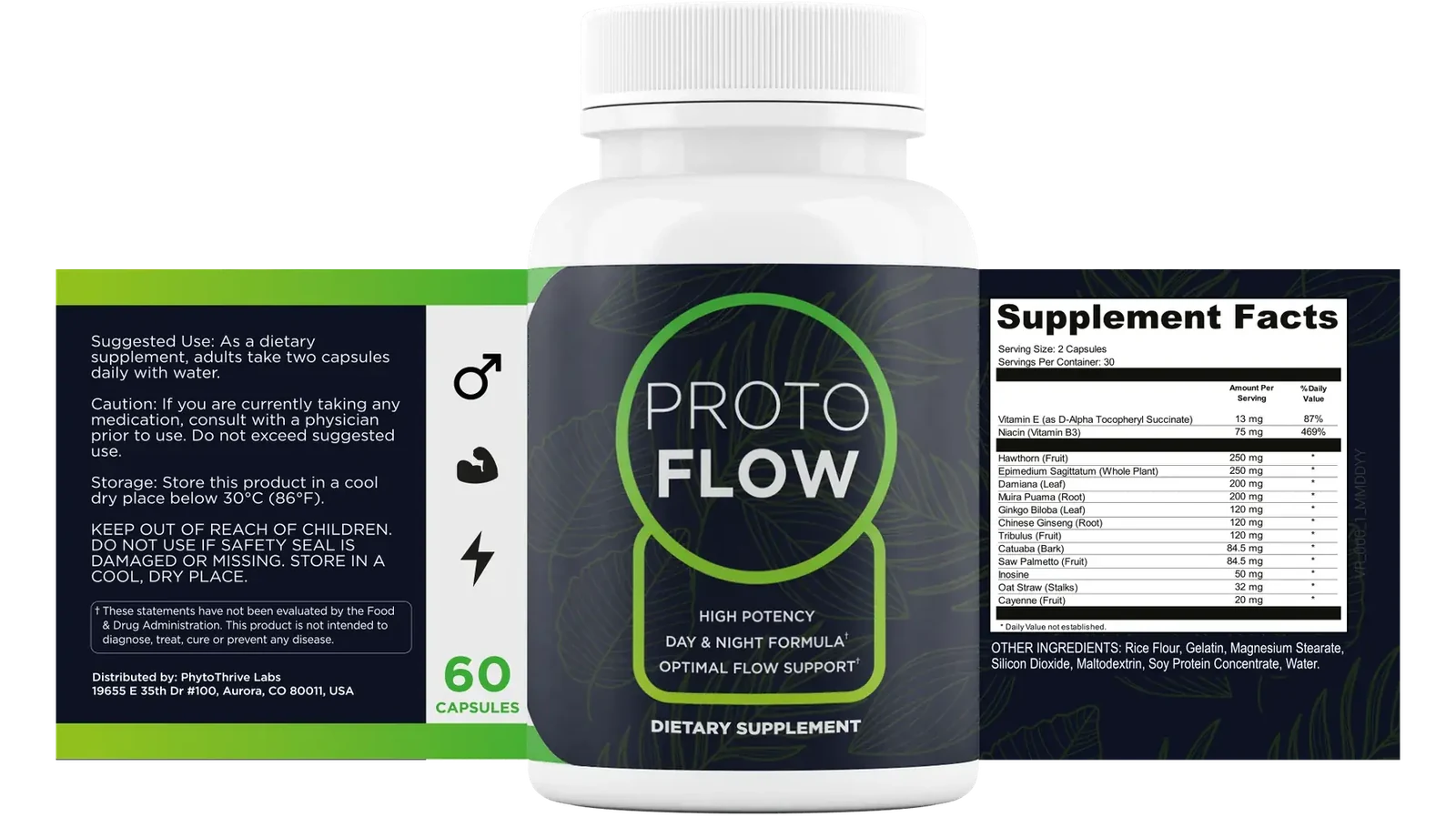
Suggested use
As a dietary supplement, adults take two capsules daily with water.
Two capsules is one serving and the panel is written for that serving, so nothing has to be doubled or halved to read this label.
Plate VII — the gap
The listing card is headed “INSIDE PROTOFLOW — NAMED PLANT INGREDIENTS” and names eight: Chinese ginseng, cayenne pepper, damiana, saw palmetto, muira puama, epimedium sagittatum, hawthorn berries and catuaba. The panel declares fourteen. The six the card leaves out are ginkgo biloba at 120 mg, tribulus at 120 mg, inosine at 50 mg, oat straw at 32 mg, and both vitamins — including the niacin row that sits at more than twice its upper limit. Read the card’s own heading carefully and it is not quite a lie: it says named plant ingredients, and it does name eight of them. It just does not name the other three plants, or either vitamin.
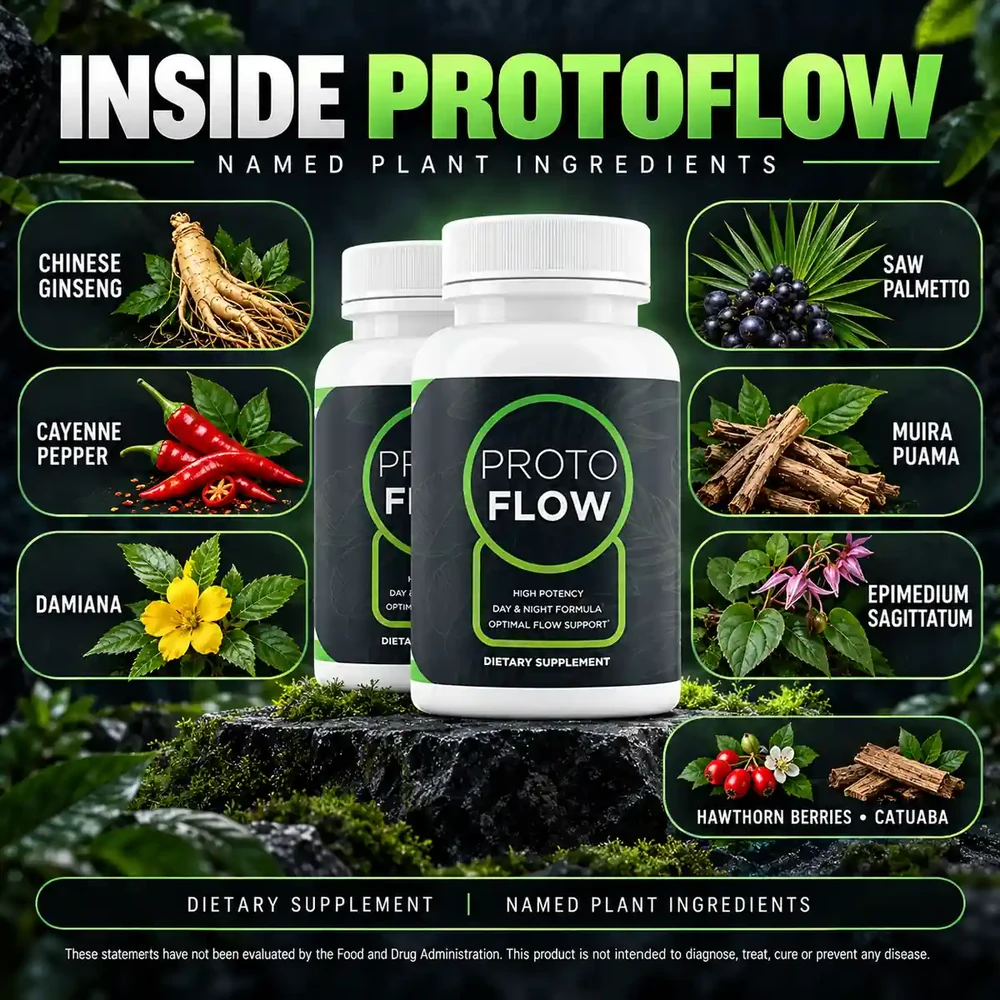
Count the rows on the panel before you read the card. A marketing image is chosen; a Supplement Facts panel is required. When the two numbers differ, what is missing from the picture is usually more interesting than what is in it.
Plate VIII — the evidence
NCCIH publishes a plain-language summary called Herbs at a Glance covering fifty-three herbs. Four of this formula’s eleven botanicals have a page there: hawthorn, ginkgo, Asian ginseng and saw palmetto. Seven do not — epimedium, damiana, muira puama, catuaba, tribulus, oat straw and cayenne. And the four that are covered are not a good result for the bottle. NCCIH on saw palmetto: a 2023 review of 27 studies found the herb “provides little or no benefit for BPH symptoms”. On ginkgo: “There’s no conclusive evidence that ginkgo is helpful for any health condition.” On hawthorn: “There is conflicting evidence on the effects of hawthorn in people with heart failure.” Only Asian ginseng returns anything positive, and the finding is narrow: it “seems to improve sexual function in people with erectile dysfunction”.
Absence of a federal page is not evidence that a herb does nothing. It means no federal body has found enough published human research to write a consumer summary about it. On a fourteen-row panel, knowing which rows are in that position tells you how much of the bottle you are buying on trust.
| Botanical | In Protoflow | Federal page? | What it reports |
|---|---|---|---|
| Hawthorn | 250 mg | Yes | NCCIH: studied for heart failure; evidence conflicting |
| Epimedium sagittatum | 250 mg | No | No NCCIH Herbs at a Glance page |
| Damiana | 200 mg | No | No NCCIH Herbs at a Glance page |
| Muira puama | 200 mg | No | No NCCIH Herbs at a Glance page |
| Ginkgo biloba | 120 mg | Yes | NCCIH: no conclusive evidence for any health condition |
| Chinese ginseng | 120 mg | Yes | NCCIH: seems to improve sexual function in people with ED |
| Tribulus | 120 mg | No | No NCCIH Herbs at a Glance page |
| Catuaba | 84.5 mg | No | No NCCIH Herbs at a Glance page |
| Saw palmetto | 84.5 mg | Yes | NCCIH: little or no benefit for BPH symptoms |
| Oat straw | 32 mg | No | No NCCIH Herbs at a Glance page |
| Cayenne | 20 mg | No | No NCCIH Herbs at a Glance page |
Inosine is not a botanical and has no federal consumer page either, which makes twelve of the fourteen rows with no summary or a negative one.
Plate IX — the safety row
Three of the fourteen rows carry the same published warning, and they are in the same capsule. Vitamin E, per NIH ODS, “can increase the risk of bleeding in people taking anticoagulant or antiplatelet medicines, such as warfarin (Coumadin)”. Ginkgo, per NCCIH, “may increase the risk of bleeding in people who are taking anticoagulant drugs, such as warfarin”. Asian ginseng, per NCCIH, “may worsen autoimmune disorders and interfere with blood clotting”. None of those three amounts is extreme on its own. The point is that they arrive together, in one bottle, taken twice a day, by an age group that is more likely than most to be on a blood thinner already.
“If you are currently taking any medication, consult with a physician prior to use. Do not exceed suggested use.”
Read a multi-botanical panel for repeats, not just for totals. When three separate rows carry the same caution, the caution is the formula’s, not the ingredient’s. The label’s own line — consult a physician if you take any medication — is the right instruction, and this is the formula that earns it.
Plate X — the summary
Everything the label and the supplied pack state, in one table, with “not published” wherever they state nothing.
Plate XI — the routine
The label prints the instruction in one sentence: “As a dietary supplement, adults take two capsules daily with water.” Two capsules is one serving, the panel is written for that serving, and sixty capsules is thirty days. The front of the bottle calls it a “day & night formula”, but the directions do not split the two capsules between a morning and an evening, so nothing on the label tells you to.
The 60-day money-back window runs from the date of purchase rather than from your first capsule. It is the single most useful thing to note before you start.
The whole instruction, word for word: “As a dietary supplement, adults take two capsules daily with water.” The front says day and night formula; the directions do not split the serving, so pick one time and keep it.
This product supplies 75 mg a serving against a 35 mg adult upper limit from supplements. Add in any B-complex, pre-workout or energy drink before you decide.
Vitamin E, ginkgo and Asian ginseng all carry published anticoagulant cautions and they are in the same capsule. The label says the same thing in one sentence.
The guarantee closes 60 days after purchase whichever pack you bought. On six bottles you will still have four sealed.
Plate XII — the dossiers
Each row with what it is, what the federal page covering it actually found, and how far this amount sits from anything studied. Tap any row to open it.
Vitamin E
First on the panel, at 87% of a Daily Value, and in the natural form.
A fat-soluble antioxidant. ODS: “In the body, it acts as an antioxidant, helping to protect cells from the damage caused by free radicals.” It also “helps boost immune function and supports blood vessel health”.
The form printed here is <em>D</em>-alpha tocopheryl succinate — the natural one. ODS is explicit that this matters: “The natural form is more potent; 1 mg vitamin E = 1 mg d-alpha-tocopherol (natural vitamin E) = 2 mg dl-alpha-tocopherol (synthetic vitamin E).” Using the natural form and printing the single <em>d</em> is a small, correct detail that many labels get wrong.
In Protoflow: 13 mg Reference: ODS: RDA 15 mg; upper limit 1,000 mg from supplements
13 mg against a 15 mg RDA is 87%, which is exactly what the panel prints. The arithmetic checks out.
Niacin
The row to look at first, and the one the marketing card does not mention.
ODS: “Niacin (also called vitamin B3) helps turn the food you eat into the energy you need.” At pharmacological doses it is also an old lipid drug — high-dose nicotinic acid “can lower blood levels of LDL (bad) cholesterol, raise levels of HDL (good) cholesterol, and lower levels of triglycerides”, although ODS adds that those effects “don’t affect the risk of having a cardiovascular event”.
75 mg is <strong>more than twice the 35 mg adult upper limit</strong> for niacin from supplements. ODS: supplements with 30 mg or more of nicotinic acid can make “the skin on your face, arms, and chest turn red and burn, tingle, and itch”, and this “can also lead to headaches, rashes, and dizziness”.
In Protoflow: 75 mg Reference: ODS: RDA 16 mg NE (men); upper limit 35 mg from supplements
The label does not say which form of niacin this is. Nicotinic acid flushes; niacinamide does not. On a 75 mg row that one missing word is the whole difference in how the capsule will feel.
Hawthorn
Joint largest row on the panel, and one of only four with a federal page.
A hedgerow berry with a long traditional use. NCCIH: historically it was used for “heart disease, digestion, blood circulation, and kidney and bladder problems”, and today it is promoted for cardiovascular health, weight loss and anxiety.
NCCIH: “Hawthorn has been studied for heart failure in people”, and “There is conflicting evidence on the effects of hawthorn in people with heart failure.” Beyond that: “There isn’t enough evidence to know whether hawthorn affects heart disease, angina, abnormal heartbeat, or the buildup of plaque in arteries.”
In Protoflow: 250 mg Reference: NCCIH: studied for heart failure; evidence conflicting
Studied in people who already have heart failure. That is a different population from a healthy adult buying a flow supplement, and the finding in that population is conflicting rather than positive.
Epimedium sagittatum
Joint largest row, and the largest row with no federal consumer summary.
A flowering plant used in traditional Chinese medicine, sold in the West under a name this site will not print because it is a marketing name rather than a botanical one. The panel uses the botanical name, which is the better practice.
<strong>NCCIH has no page for it.</strong> Its Herbs at a Glance series covers fifty-three herbs and this is not one of them, which means no federal body has published a plain-language summary of what the human research shows.
In Protoflow: 250 mg Reference: No NCCIH Herbs at a Glance page
Two hundred and fifty milligrams is a real amount of something. What it is an amount of is not stated: the panel gives no extract ratio and no standardisation, so “whole plant” could be milled leaf or a concentrate many times stronger.
Damiana
Third by weight, and the second row with no federal page.
A small shrub from Central and South America whose leaf has a long folk history as a tonic.
No NCCIH page, and no ODS fact sheet. There is no federal consumer summary to weigh this against, which is why this site prints the amount and stops.
In Protoflow: 200 mg Reference: No NCCIH Herbs at a Glance page
200 mg of leaf, unstandardised. As with every botanical row here, the figure describes weight, not activity.
Muira puama
Joint third by weight. Also without a federal page.
An Amazonian shrub whose root and bark are used traditionally. It appears in most formulas of this shape.
No NCCIH page and no ODS fact sheet. Nothing federal to cite either way.
In Protoflow: 200 mg Reference: No NCCIH Herbs at a Glance page
The panel says root. Some commercial material uses bark, and the two are not interchangeable, so naming the part is a point in the label’s favour.
Ginkgo biloba
120 mg, a federal page, and <strong>not named on the marketing card</strong>.
One of the most-studied botanicals in the world, usually sold for memory and circulation.
NCCIH is blunt: “There’s no conclusive evidence that ginkgo is helpful for any health condition.” On dementia: it “has not been shown to be beneficial for preventing or slowing the progression of dementia”, though extract “may have a modest benefit for dementia symptoms, particularly at relatively high doses, but the evidence is inconsistent”. In healthy people, “It’s uncertain whether they actually influence cognitive performance”.
In Protoflow: 120 mg Reference: NCCIH: no conclusive evidence for any health condition
This is one of the six rows the “Inside Protoflow” card omits. It is also one of the four rows here that a federal body has actually summarised — and the summary is negative.
Chinese ginseng
The only row on this panel where a federal page reports something positive.
Asian or Chinese ginseng, the root used across East Asian traditional medicine and one of the best-studied herbs in the NCCIH series.
NCCIH: “Taking oral Asian ginseng seems to improve sexual function in people with erectile dysfunction (ED).” It also “may improve cognitive function… in middle-aged adults but not in young adults” and “may have a small beneficial effect on general fatigue”. Against that: “The majority of research shows that Asian ginseng does not improve athletic performance.”
In Protoflow: 120 mg Reference: NCCIH: seems to improve sexual function in people with ED
That ED finding is the closest thing this bottle has to supporting evidence, and it is worth noting what the research used. NCCIH does not publish a dose for it, and 120 mg of unstandardised root is at the modest end of what is sold.
Tribulus
120 mg, no federal page, and not on the marketing card either.
A low creeping plant whose fruit is sold across the sports and men’s categories, usually with testosterone language attached to it.
No NCCIH page and no ODS fact sheet. The testosterone framing that normally travels with this ingredient appears nowhere on this label — it appears in the title of a bundled ebook instead.
In Protoflow: 120 mg Reference: No NCCIH Herbs at a Glance page
One of the six rows the “Inside Protoflow” card leaves unnamed, despite being joint fifth by weight.
Catuaba
An oddly precise 84.5 mg, and no federal page.
A Brazilian bark. The name is applied commercially to more than one botanical species, which is part of why a label naming only “catuaba” tells you less than it looks like it does.
No NCCIH page and no ODS fact sheet.
In Protoflow: 84.5 mg Reference: No NCCIH Herbs at a Glance page
84.5 mg is a strangely exact figure for a bark. It is the kind of number that falls out of a pre-made blend being split into rows rather than each row being chosen.
Saw palmetto
The ingredient most buyers will recognise, at the second-smallest botanical amount on the panel.
The fruit of a palm native to the south-eastern United States, sold for decades for urinary symptoms in an enlarged prostate.
NCCIH: “A 2023 review of 27 studies on saw palmetto in men with BPH found that this herb, when administered alone, provides little or no benefit for BPH symptoms.” And in two further trials, “saw palmetto did not improve BPH symptoms”.
In Protoflow: 84.5 mg Reference: NCCIH: little or no benefit for BPH symptoms
Most saw palmetto research uses 320 mg a day of a standardised extract. This panel has 84.5 mg of unstandardised fruit. Even if the reviews had been positive, this is roughly a quarter of the studied amount in a different preparation.
Inosine
Not a plant, and not named on a card headed “named plant ingredients”.
A purine nucleoside involved in cellular energy metabolism. It is manufactured, not harvested, and it has been sold to athletes for decades.
No NCCIH page and no ODS fact sheet. It is also the ingredient that makes the “100% natural” roundel hard to defend.
In Protoflow: 50 mg Reference: No federal consumer fact sheet
Fifty milligrams, unremarked on anywhere in the supplied marketing.
Oat straw
Second smallest row, and relevant to a seal the label never earns.
The green stalk of the oat plant, harvested before the grain sets.
No NCCIH page. Worth one note of its own: oats sit close to wheat in the field and in the mill, and the supplied pack ships a <em>gluten free</em> roundel for a label that makes no gluten claim and publishes no test.
In Protoflow: 32 mg Reference: No NCCIH Herbs at a Glance page
32 mg is about a thirtieth of a gram. It is a listing ingredient.
Cayenne
The smallest row on the panel, and one of the eight the card puts a photograph to.
Chilli fruit. In this category it is included on a circulation argument.
No NCCIH Herbs at a Glance page. Capsaicin has a research literature of its own, largely topical, which is a different thing from 20 mg of milled fruit in a capsule.
In Protoflow: 20 mg Reference: No NCCIH Herbs at a Glance page
Twenty milligrams is a pinch. It is less than a tenth of the hawthorn row and about a fiftieth of a teaspoon.
Plate XIII — the claims
The label claims two things and both are correctly written: “day & night formula” and “optimal flow support”, each with the FDA disclaimer attached. The bottle says “optimal flow support” and does not say flow of what. Read against the formula — saw palmetto, epimedium, muira puama, damiana, catuaba, tribulus — this is the vocabulary of two adjacent categories: urinary flow in an ageing prostate, and blood flow for erectile function. The label is careful not to name either, which is correct, because naming either would turn a structure/function claim into a disease claim. But the formula is doing the naming the label will not.
The three- and six-bottle packs arrive with four digital bonuses, and two of them say things the bottle does not. “10 Ways to Turbocharge Your Testosterone” names a hormone; the label’s claims are “optimal flow support” and “day & night formula”, and it names nothing. “Supercharge Your Body: A Step-By-Step Plan to Boosting Your Immune System” makes an immune claim the panel never makes. The other two are “Biohacking Secrets” and a “24 Hours Detox Guide”. A bonus is not a label, nobody has to substantiate its title, and a title is the part a buyer reads.
Plate XIV — the fit
Three groups this product genuinely suits.
Fourteen rows, fourteen figures, no proprietary blend. In this category that is rare enough to be the main reason to prefer this bottle over most of its shelf. You may not like what the figures say — we do not — but you can see them, and you cannot see them on most competitors.
Ginseng is the one row on this panel where a federal body reports something positive: NCCIH says oral Asian ginseng “seems to improve sexual function in people with erectile dysfunction”. At 120 mg of unstandardised root this is a modest amount of it, and you would get more from a single-ingredient product, but it is here and it is declared.
If you have already decided you want a broad men’s botanical stack, one bottle with every amount printed is a more honest way to buy it than eight single-herb bottles with eight different labels.
And five it does not. The first is decided by the label itself.
This is the clearest exclusion on the product and it is decided by the label. The other-ingredients line reads “Rice Flour, Gelatin, Magnesium Stearate…” Gelatin is boiled-down animal collagen. The vegetarian mark in the marketing pack does not change what is in the capsule.
Three rows — vitamin E, ginkgo and Asian ginseng — carry published anticoagulant cautions, and they are in the same capsule twice a day. ODS on vitamin E: it “can increase the risk of bleeding in people taking anticoagulant or antiplatelet medicines, such as warfarin”. This is a pharmacist question, not a comment-section question.
75 mg is more than twice the 35 mg supplemental upper limit, and ODS reports that 30 mg or more of nicotinic acid can turn the skin of the face, arms and chest red, burning and itchy. The label does not say which form of niacin it uses.
Saw palmetto is the ingredient people buy for that, and NCCIH’s 2023 review of 27 studies found it “provides little or no benefit for BPH symptoms”. This bottle has 84.5 mg of unstandardised fruit against the roughly 320 mg of standardised extract the trials used. MedlinePlus is plain that these symptoms “could be from a more serious health problem”.
NCCIH: Asian ginseng “may worsen autoimmune disorders” and “might lower blood sugar levels”. Both are conversations to have before the first capsule rather than after.
Nothing is sent anywhere. The answers are worked out in your browser and forgotten when you close the tab.
Are you vegetarian or vegan?
Do you take a blood thinner, an antiplatelet, or aspirin daily?
Do you already take niacin, or a B-complex, or a pre-workout?
Do you have an autoimmune condition, thyroid disease, or diabetes?
What are you hoping it does?
Plate XV — the comparison
| Protoflow | Most of the category | What the difference is worth |
|---|---|---|
| Protoflow: none - all fourteen amounts printed | Most men’s botanical formulas: one blend, no split | This is the row Protoflow wins outright, and it is not a small one. |
| Protoflow: 14 | Typical: 6 to 10, often inside a blend | A long list, and here you can actually read it. |
| Protoflow: none stated on any botanical | Better labels: a ratio or a marker compound | Without one, a milligram figure is weight rather than activity. |
| Protoflow: gelatin, named in the other-ingredients line | Vegetarian products: hypromellose or cellulose | Named honestly on the label, and contradicted by the pack’s own seal. |
| Protoflow: none printed | Most US supplement labels: a contains or free-from line | Soy appears inside the ingredient list, which is where the law requires it. |
| Protoflow: no - a distributor only | Better labels: a manufacturer, or a contact route for one | No phone, no email and no website anywhere on the wrap. |
| Protoflow: niacin at 469% DV | Most: at or under 100% of a Daily Value | More than twice the 35 mg supplemental upper limit. |
| Protoflow: 4 of 11 | Single-ingredient products: usually the one you are buying | Seven rows have no NCCIH summary at all. |
| Protoflow: a vegetarian seal over gelatin | Honest packs: the seal matches the panel | The single clearest conflict in the supplied material. |
| Protoflow: not supplied | Most: printed on the listing | Every figure on this site reads shown at checkout. |
Ten rows. This product wins the first two outright, and they are not small ones.
It is worth being clear about what that table does and does not say. It measures how this product is documented, not whether it works. A label can publish every amount honestly and the amounts can still be a fraction of anything studied — and on this product both of those things are true at once.
Plate XVI — the packs
No pack price was supplied. The supply arithmetic is exact anyway, because the panel and the directions agree.
Smallest pack
60 capsules · 30 days
30 days at the label’s two-capsule serving
Most popular, per the seller
180 capsules · 90 days
90 days at the label’s two-capsule serving
Top pack, per the seller
360 capsules · 180 days
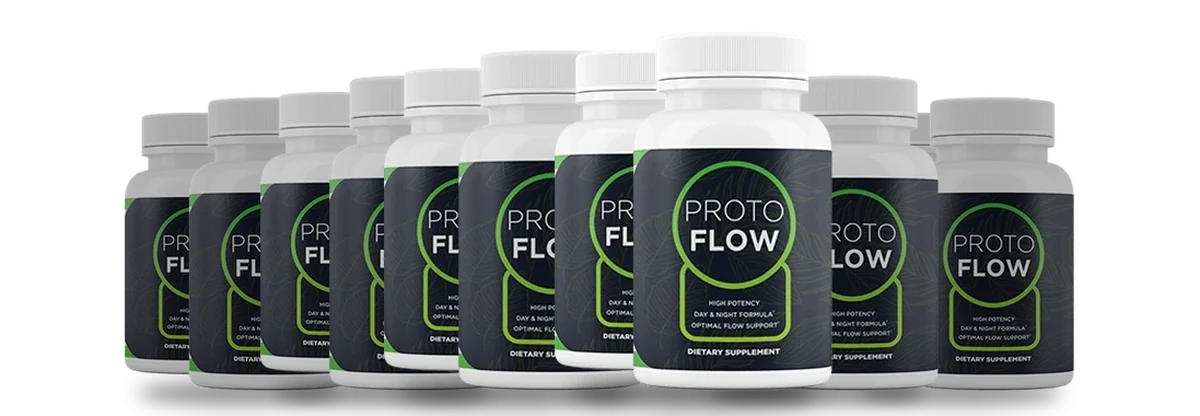
180 days at the label’s two-capsule serving
No pack price was supplied to us, so every price on this site reads “shown at checkout”. The figure you will be charged is printed on the sales page and that is the only place it is binding.
The supply arithmetic is exact even when the price is not, because the label’s serving and the panel’s serving are the same two capsules. Sixty capsules is thirty days. One bottle is a month, three is a quarter, six is half a year. Whatever a bottle costs, divide by thirty for your cost a day.
Set the window against the packs at two capsules a day. One bottle is 30 days of product inside a 60-day window — you finish with a month still to claim in. Three bottles is 90 days, so the last month falls outside it. Six bottles is 180 days: when the window shuts you will have taken two bottles and four will still be sealed.
One, three or six bottles. Each bottle is 60 capsules — thirty days at the label’s two-capsule serving. No price was supplied; it is shown at checkout.
Compare the three packsPlate XVII — the bundle
The three- and six-bottle packs arrive with four digital bonuses, and two of them say things the bottle does not. “10 Ways to Turbocharge Your Testosterone” names a hormone; the label’s claims are “optimal flow support” and “day & night formula”, and it names nothing. “Supercharge Your Body: A Step-By-Step Plan to Boosting Your Immune System” makes an immune claim the panel never makes. The other two are “Biohacking Secrets” and a “24 Hours Detox Guide”. A bonus is not a label, nobody has to substantiate its title, and a title is the part a buyer reads.
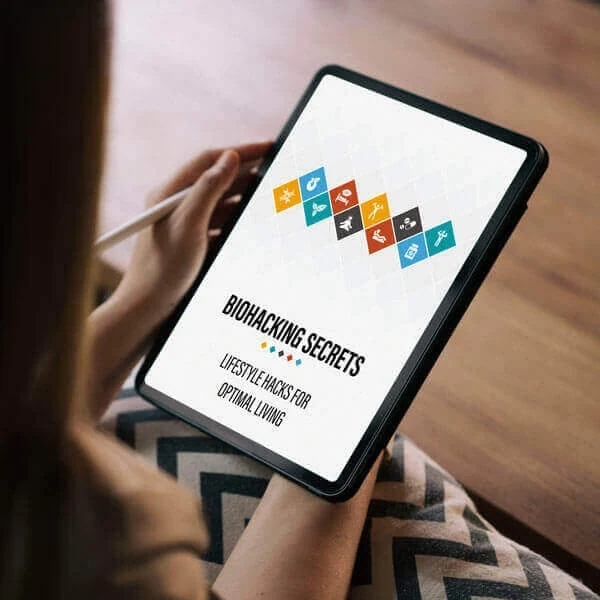
A general lifestyle title. It claims nothing the bottle would have to stand behind.
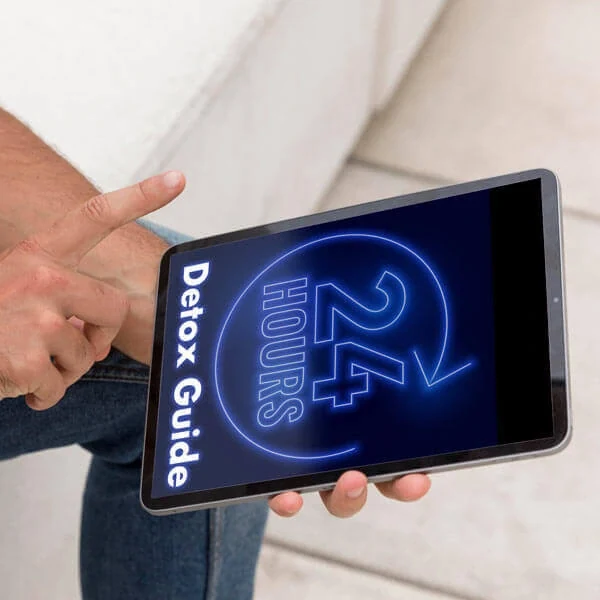
“Detox” is a marketing word rather than a physiological one. The liver and kidneys do this job continuously and no guide changes that.
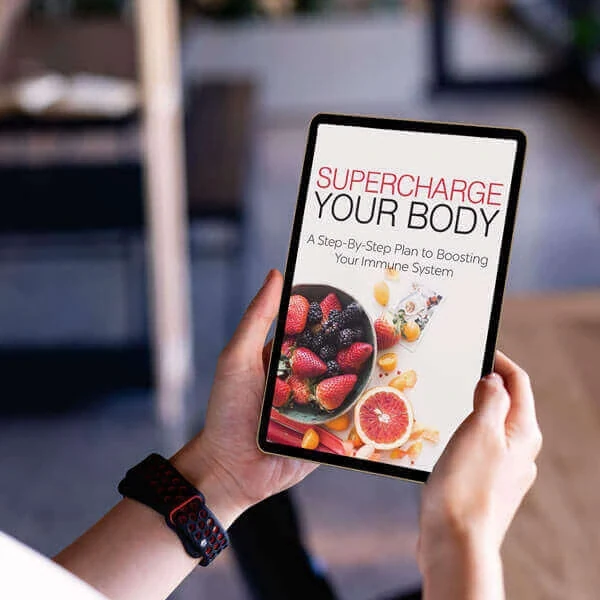
An immune claim. The label makes none. A bonus title is not a label claim and nobody has to substantiate it.
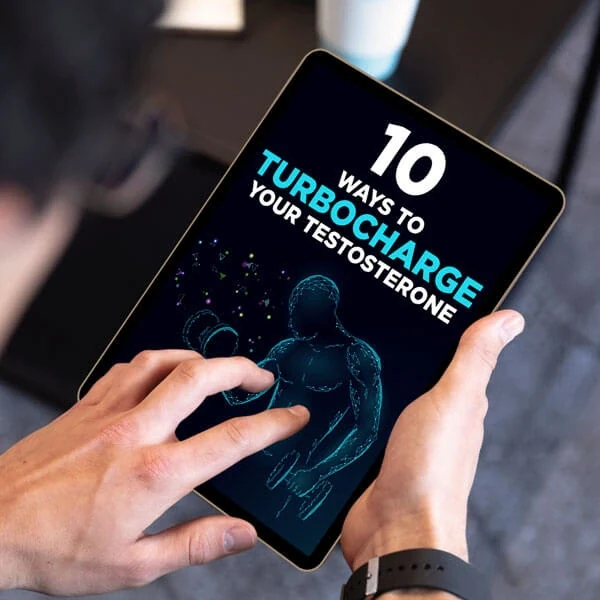
A hormone claim. The bottle says “optimal flow support” and names nothing. This title names a hormone. It is the clearest example on this product of the bundle saying more than the label does.
When a supplement arrives with reading material, check whether the reading material claims more than the bottle does. A correctly written label sitting inside a bundle whose titles name hormones and immune systems is a common shape, and the bundle is the part nobody has to stand behind.
Plate XVIII — the safety
This label carries its own caution panel, so we can start with what the manufacturer says rather than with what is missing:
“If you are currently taking any medication, consult with a physician prior to use. Do not exceed suggested use.”
Niacin. ODS: supplements with 30 mg or more of nicotinic acid can make “the skin on your face, arms, and chest turn red and burn, tingle, and itch. This can also lead to headaches, rashes, and dizziness.” Long-term high-dose use “can cause liver problems, including hepatitis and liver failure.” The adult upper limit is 35 mg and this serving is 75 mg.
Vitamin E, ginkgo and Asian ginseng. All three carry published bleeding cautions. ODS: “Vitamin E can increase the risk of bleeding in people taking anticoagulant or antiplatelet medicines, such as warfarin (Coumadin).” NCCIH: “Ginkgo may increase the risk of bleeding in people who are taking anticoagulant drugs, such as warfarin.” And: “Asian ginseng may worsen autoimmune disorders and interfere with blood clotting.”
Asian ginseng, beyond bleeding. NCCIH: “Insomnia (trouble sleeping) is the herb’s most common side effect.” and “Asian ginseng might lower blood sugar levels.” Uncommon effects include “Uncommon side effects that have been reported include severe rash, liver damage, and severe allergic reactions.”
Hawthorn. NCCIH: “No research studies have tested whether it is safe to use hawthorn for more than 16 weeks.” The six-bottle pack is half a year. Side effects listed are “dizziness, nausea, vomiting, diarrhea, and muscle pain.”
Seven botanicals with no page at all. Epimedium, damiana, muira puama, catuaba, tribulus, oat straw and cayenne have no NCCIH summary. That is an absence of published information rather than a finding of safety.
MedlinePlus on erectile difficulty: “ED can be a sign of health problems. It may mean your blood vessels are clogged. It may mean you have nerve damage from diabetes.” On an enlarged prostate: the symptoms “could be from a more serious health problem”. NCCIH’s general rule applies here too — “Take charge of your health—talk with your health care providers about any complementary health approaches you use.”
Plate XIX — the timeline
Nothing below describes what the product does, because no trial of it has been published. The first row is the one that matters most.
First: if you are on a blood thinner, an antiplatelet, a diabetes medicine or anything for an autoimmune condition, three rows on this panel are a pharmacist conversation. The label says so itself. Second: if the reason you are buying this is a urinary symptom or erectile difficulty, MedlinePlus is worth reading before the sales page — “ED can be a sign of health problems. It may mean your blood vessels are clogged.”
What is not known: No trial of this formula has been published.
Two capsules daily with water. The label does not say morning or evening and does not split them, so pick one time and keep it. Write down the date you paid: the 60-day window runs from then, not from your first capsule. If you flush — face and chest going red, hot and itchy — that is the niacin row, and it is the most likely thing you will notice in the first fortnight.
What is not known: Nothing is published about what the first two weeks of this formula do.
The seller’s own listing says buyers most often waited three to six weeks. Read that as a description of expectation rather than of effect — the pack that supplied the figure calls its own review block layout copy. At two capsules a day you will be through one bottle and into a second.
What is not known: No published trial covers this combination at these amounts over any period.
Day 60 is the last day of the guarantee whichever pack you bought. On one bottle you will have finished the product with a month of window left. On six you will be four bottles ahead of the deadline, and past the sixteen weeks beyond which NCCIH says hawthorn safety has not been tested.
What is not known: The window runs from purchase, not from your first capsule.
Plate XX — the direct question
It is a fair question, and the honest answer has two halves that point in opposite directions.
A fake product does not publish fourteen amounts. It uses a proprietary blend, which is legal, universal in this category, and hides exactly the arithmetic this page has spent two thousand words doing. Protoflow does not use one. The front-of-label claims are correctly written and correctly disclaimed. The vitamin E is the natural form and its %DV is right. The niacin %DV is right too. The caution line tells anyone on medication to see a physician, which is the correct instruction for this formula. The order line dials.
The other-ingredients line says gelatin and the marketing pack ships a vegetarian seal. A “100% natural” roundel sits above maltodextrin, silicon dioxide and a manufactured nucleoside. The card names eight ingredients on a panel that declares fourteen. Seven of the eleven botanicals have no federal consumer page, and of the four that do, three report no benefit or conflicting evidence. Not one botanical carries a standardisation. A bonus ebook names a hormone the bottle never mentions. And the review block in the supplied pack is described by that pack as layout copy.
This is a real supplement with an unusually readable label and a marketing layer that does not match it. If you want a broad men’s botanical stack and you want to see every amount, this is a more honest way to buy one than most of its shelf. If you are vegetarian, on a blood thinner, or buying it for a specific symptom, the label and the federal pages both say no — and on the first of those the label says it more clearly than the seal does.
Plate XXI — ordering
Theprotoflow describes itself as a U.S. stocking partner for Protoflow, and the order button points at the brand’s own sales page. The seller’s own wording is “U.S. stocking partner for Protoflow”. It describes a reseller arrangement. It is not a licence, no agency issues one for selling dietary supplements, and no register or number is named in the material we were given.
The order button points at the brand’s own information and sales page, where the checkout is operated by BuyGoods. This site earns a commission if you buy through it. That does not change your price. We do not print the address as text anywhere, and the earnings disclosure is on the disclaimer page.
The checkout on the sales page is operated by BuyGoods, a payment processor. The order line supplied to this desk is BuyGoods’ default order desk, which is why it can help with an order and cannot help with a question about the formula.
The price, and the guarantee wording with the date visible. Neither is published on this site because neither was supplied to us, and both are things you will want a record of if a refund becomes a conversation.
The order line supplied to this desk is +1 (302) 200-3480, described in the pack as the BuyGoods default order desk. It is an ordinary, dialable Delaware number. Note whose desk it is: BuyGoods is the payment processor that runs the checkout, not the brand and not the manufacturer. The label itself prints no phone number and no email at all — just a distributor and a street in Aurora, Colorado. If you have a question about what is in the bottle rather than about your order, there is no published route to anyone who would know.
Plate XXII — the reviews
The seller’s figures, not ours
The supplied pack describes its own review block, in its own words, as “layout copy only”. It is right to. Three of the eight named buyers carry the same sentence word for word — “Daily habit stuck. Reordered before the last bottle.” — and three more share a second one. That is placeholder text with names attached, not collected testimony, so none of it is published here.
How we source a factPlate XXIII — straight answers
No. The other-ingredients line printed on the wrap reads “Rice Flour, Gelatin, Magnesium Stearate, Silicon Dioxide, Maltodextrin, Soy Protein Concentrate, Water.” Gelatin is made from animal collagen. The vegetarian roundel in the marketing pack is contradicted by the bottle it is advertising, and we would rather tell you that here than have you find it at home.
It is not a strength rating. Niacin has a published upper limit of 35 mg a day from supplements and this serving is 75 mg. ODS reports that 30 mg or more of nicotinic acid can make the skin of your face, arms and chest turn red and burn, tingle and itch. If you flush in the first week, that is the row doing it.
Because the card is a marketing image and the panel is a regulated document. The card is headed “named plant ingredients” and names eight of them; the panel declares fourteen rows. The six it leaves out are ginkgo, tribulus, inosine, oat straw, vitamin E and niacin.
Nothing on the label claims it will, and the ingredient people buy for that has been reviewed and found wanting. NCCIH, on a 2023 review of 27 studies: saw palmetto “provides little or no benefit for BPH symptoms”. This bottle contains about a quarter of the amount those studies used, in an unstandardised form. Urinary symptoms are worth taking to a doctor because, as MedlinePlus puts it, they “could be from a more serious health problem”.
No. The bottle says “optimal flow support” and “day & night formula”, both with the FDA disclaimer attached, and it names no hormone and no condition. The bonus title does. A bonus is not a label and nobody has to substantiate it.
Because none was supplied to us. Estimating one and having you charged something else at checkout would be worse than saying so.
Plate XXIV — money back
The pack states 60 days from purchase, unless the sales page prints a longer window. Note where it starts: from the date you pay, not from your first capsule. Read it on the sales page before you pay and screenshot it with the date showing.
Call the order desk on +1 (302) 200-3480 with your order ID. Returns go to 122 East 42nd Street, Floor 18, New York, NY 10168, USA. Include your full name, the email on the order and the order ID. Return postage is paid by the buyer. Use a tracked service. Refunds are credited 3 to 5 business days after the desk approves them, then 5 to 10 days for the card to post it.
The sales email supplied to this desk is [email protected], which belongs to the brand’s own information site rather than to this one. The website address below cannot see your order, your tracking or your refund.
It is a seller’s promise, not a regulator’s rule. No agency enforces a supplement money-back window. Read it on the sales page before you pay, screenshot it with the date showing, and keep the order email.
Plate XXV — the verdict
Eight rows, scored on what is published rather than on what is promised. One of them is the highest mark on the card and one is the lowest we have given.
| What we scored | Mark | Why |
|---|---|---|
| Label transparency | 8/10 | Fourteen ingredients, fourteen published amounts, and no proprietary blend — which in a men’s botanical formula is genuinely unusual, because the blend is normally where this category hides its arithmetic. Marked down because there is no allergen statement, no extract ratio on any of the eleven botanicals, and no manufacturer named. |
| Panel and directions agree | 9/10 | The panel is written for two capsules and the directions ask for two capsules. Sixty capsules is thirty days on both readings and no arithmetic is needed to reconcile them. One mark off because the front calls it a day and night formula and the directions never split the serving. |
| Amounts against the research | 3/10 | Saw palmetto is at 84.5 mg where the trials use about 320 mg of a standardised extract. Cayenne is 20 mg. Oat straw is 32 mg. Eleven botanical rows and not one standardisation, so every figure describes weight rather than activity. |
| Evidence for what the marketing implies | 2/10 | Seven of the eleven botanicals have no NCCIH page at all. Of the four that do, saw palmetto shows “little or no benefit”, ginkgo has “no conclusive evidence… for any health condition”, and hawthorn is “conflicting”. Only Asian ginseng returns a positive finding. |
| Marketing against the label | 1/10 | A vegetarian seal on a bottle whose other-ingredients line says gelatin. A 100% natural seal above maltodextrin, silicon dioxide and a manufactured nucleoside. A card naming eight ingredients on a panel that declares fourteen. A bonus ebook naming a hormone the label never mentions. This is the row that carries the product’s real problem. |
| Price clarity | 2/10 | No pack price was supplied. Every figure on this site reads “shown at checkout”. |
| Money-back window | 6/10 | Sixty days from purchase, per the supplied pack. A real number with a real start date, though it appears in the pack rather than on the label. |
| Support and contact | 4/10 | The order line is an ordinary, dialable number — but it is the payment processor’s default desk, not the brand’s. The label itself prints no phone, no email and no website at all: a street address in Aurora, Colorado and nothing else. |
Plate XXVI — plainly
Fourteen ingredients, fourteen amounts, no proprietary blend. In a men’s botanical formula that is unusual. A blend is exactly where this category normally hides how little of each herb is in the capsule, and this product does not use one. Every criticism further down this page is only possible because the label lets you make it.
If you are vegetarian, the bottle is not for you, and you would not learn that from the seal. You would learn it from the second word of the other-ingredients line. That is the whole reason this site prints the other-ingredients line in full on four different pages.
Fourteen rows sounds like more product. Seven of the eleven botanicals have no federal consumer page, none of the eleven carries a standardisation, and the best-known one is at about a quarter of its studied amount. Length and strength are different measurements.
Not because 75 mg is dangerous on its own for most people, but because it is over a published ceiling, because the form is not stated, and because it is the row most likely to interact with something else in your cupboard.
No price was supplied to this desk. Every figure on this site says “shown at checkout” and will keep saying that until somebody sends us a real one.
Plate XXVII — about
This site is run by Theprotoflow, a U.S. stocking partner for Protoflow in the United States. It is a product information site: its job is to print what the label and the seller’s material say, check each claim against a federal reference page where one exists, and write “not published” wherever a fact is missing rather than filling the gap.
The order button points at the brand’s own information and sales page, where the checkout is operated by BuyGoods. This site earns a commission if you buy through it. That does not change your price. We do not print the address as text anywhere, and the earnings disclosure is on the disclaimer page.
Contact: [email protected], Monday to Friday, 9:00am - 5:00pm ET, for anything about these pages. For anything about an order, the desk line is +1 (302) 200-3480. If the bottle in your hand disagrees with something written here, tell us — the label is the document that wins.
Plate XXVIII — references
Fourteen federal reference pages, each opened and read on September 24, 2026.
Plate XXIX — questions
Eleven of the sixty-seven on the full FAQ page.
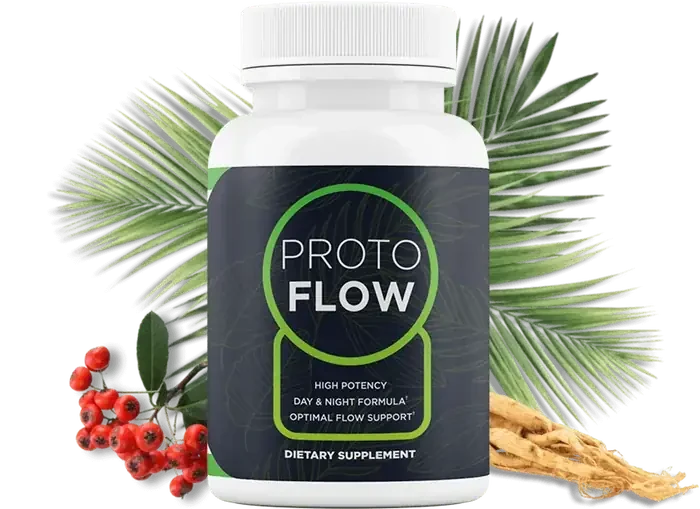
A dietary supplement sold as a capsule, 60 capsules to a white bottle with a dark green wrap. Its Supplement Facts panel declares fourteen ingredients, each with its own amount: vitamin E and niacin, then eleven botanicals — hawthorn, epimedium, damiana, muira puama, ginkgo biloba, Chinese ginseng, tribulus, catuaba, saw palmetto, oat straw and cayenne — plus inosine, which is a manufactured nucleoside rather than a plant.
<strong>No.</strong> The other-ingredients line reads “Rice Flour, Gelatin, Magnesium Stearate, Silicon Dioxide, Maltodextrin, Soy Protein Concentrate, Water.” Gelatin is made from animal collagen. The marketing pack ships a vegetarian roundel; the label contradicts it, and the label is the document that counts.
<strong>No, and that is the best thing about this label.</strong> All fourteen rows carry their own amount. In a men’s botanical formula a blend is almost standard, and it is exactly where a product hides how little of each herb is in the capsule. Protoflow does not use one.
The label does not say, and it is better for not saying. Read against the formula — saw palmetto, epimedium, muira puama, damiana, catuaba, tribulus — the vocabulary belongs to two adjacent categories: urinary flow in an ageing prostate, and blood flow for erectile function. Naming either would turn a support claim into a disease claim, which a supplement may not make.
The label says: “As a dietary supplement, adults take two capsules daily with water.” That is the whole instruction.
It is the row to ask about. 75 mg is more than twice the 35 mg adult upper limit for niacin from supplements. ODS reports that 30 mg or more of nicotinic acid can make “the skin on your face, arms, and chest turn red and burn, tingle, and itch”, and that long-term high-dose use “can cause liver problems, including hepatitis and liver failure”. The label does not say which form it uses.
Four of the eleven botanicals have a page in NCCIH’s Herbs at a Glance series: hawthorn, ginkgo, Asian ginseng and saw palmetto. Seven do not — epimedium, damiana, muira puama, catuaba, tribulus, oat straw and cayenne. Both vitamins have ODS fact sheets.
“A 2023 review of 27 studies on saw palmetto in men with BPH found that this herb, when administered alone, provides little or no benefit for BPH symptoms.” It also reports two further studies in which “saw palmetto did not improve BPH symptoms”.
The label carries its own caution: “If you are currently taking any medication, consult with a physician prior to use. Do not exceed suggested use.” On this particular formula that is the right instruction and worth following, because three separate rows carry published cautions about bleeding.
Sixty days from purchase, per the supplied pack, unless the sales page prints a longer window. Read it there before you pay and screenshot it with the date showing.
Because the pack that supplied them says, in its own words, that its reviews, star scores and order counts are layout copy only. Three of the eight named buyers carry the same sentence word for word. None of it is published here and there is no rating markup anywhere on this site.
60 capsules a bottle, two a day with water, thirty days a bottle. Fourteen ingredients with fourteen published amounts and no proprietary blend. The shell is gelatin, so it is not vegetarian. 60 days from purchase to change your mind. Price is shown at checkout. Order desk +1 (302) 200-3480.
Price shown at checkout · 60-day window from the date of purchase · ships from inside the US · the label’s own support line is +1 (302) 200-3480